
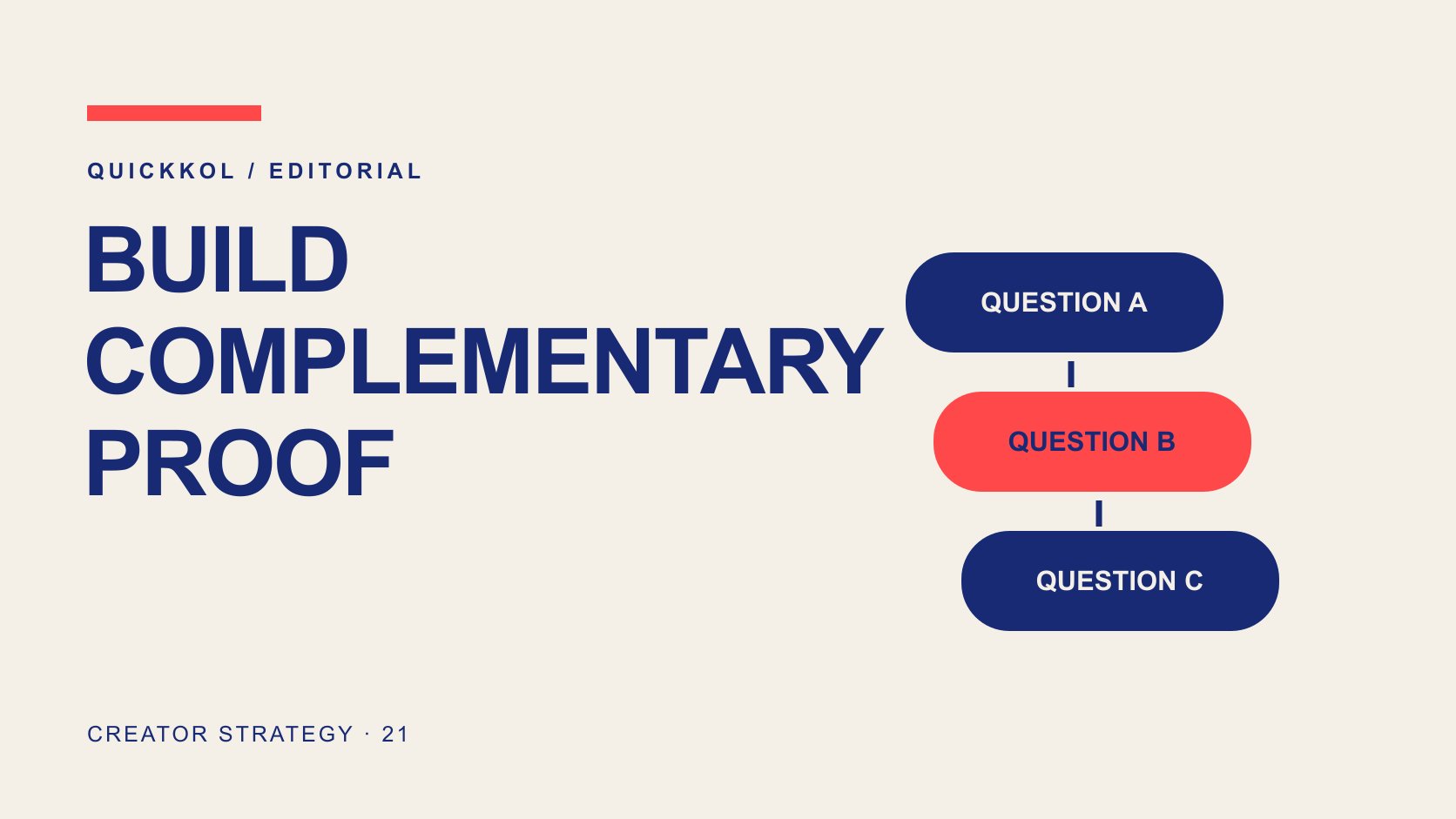
THE SHORT ANSWER
A small micro-influencer portfolio should add complementary work and executable tasks rather than simply more names or summed followers. List the product questions the brand has not yet explained, assign one primary job per creator and judge the delivered evidence. A follower range is a project condition, not a quality guarantee or a universally agreed market definition.
Start with unanswered product questions
Suppose the brand lacks clear explanations of setup, everyday use and storage limitations. First confirm these are genuine product questions rather than three invented personas designed to justify hiring three people. Audit existing assets so the plan starts with an actual information gap.
The portfolio-gap guide helps distinguish existing evidence from missing work. If a question is already answered clearly, a new member should add information, a useful format or a different supported use condition. Otherwise the purchase may duplicate what the brand already has. A small portfolio becomes easier to manage when each contribution has a reason to exist before names are added. This also prevents the team from assigning new roles merely to accommodate candidates it happens to like.
Assign roles through work evidence
Look for evidence of explaining steps, showing a real setting or describing a limitation. Do not treat demographic characteristics as content capability or give every creator the same brand monologue. A distinct perspective matters when it changes the useful information, not merely when the cast looks different in a presentation.
The work-selection guide turns fit into specific evidence. One creator can have several capabilities, but the first commission still benefits from one primary job. Otherwise the brief can touch everything without making anything reviewable. Preserve the work sample supporting the assignment so a second reviewer understands why the role was proposed. This makes the selection accountable without pretending that one past post guarantees the outcome of a new task.
Share facts while preserving distinct briefs
Shared information includes correct product specifications, unsupported claims that must not be used and necessary disclosure arrangements. Distinct information includes the primary question, setting, footage and acceptance conditions. A common fact sheet should not automatically become an identical script across the whole portfolio.
The useful-brief guide preserves this separation. Creators should understand what must be accurate and where their own expression can solve the task. Consistency matters for facts, while variation can reveal which explanation works under which conditions. Keep the review anchored to the assigned job rather than compare all creators against the most polished-looking video regardless of purpose. A clear installation explanation and a truthful limitations story can both be successful without sharing the same visual rhythm or emotional tone.
Budget by contribution and scope
Three creators do not imply three identical costs. Production, publication, licensing, travel and revisions can differ. Align comparison fields before discussing the portfolio total and priorities. The relevant question is what evidence the brand can purchase under a workable scope, not how many names can fit below an arbitrary per-person ceiling.
If the budget is insufficient, reduce tasks or narrow permission rather than retain every obligation and demand a lower fee from each person. Keep unpurchased information gaps visible for the next round. This supports an honest tradeoff: the brand may choose to learn about setup now and defer another question. It should not claim a complete test when the scope no longer contains the work required to answer every original objective.
Do not present a small portfolio as a clean experiment
When creator, timing, audience and format change together, performance differences cannot be attributed cleanly to one factor. Begin by evaluating task completion and usable evidence, then decide whether a more controlled follow-up is justified. A small portfolio can produce useful learning without being described as a statistically conclusive experiment.
The incrementality guide separates association from causation. Modash’s engagement-rate documentation also illustrates why vendor definitions need attention: compare metrics only after aligning their formulas and windows. Do not select a universal winner from interface percentages with different denominators. A descriptive conclusion can state which explanation was clearest under the observed conditions while leaving causal performance questions unresolved. That is more credible and more actionable than a league table built from incomparable observations.
Renew against the next evidence need
Record each delivery, support conditions, unresolved questions and next action. Renewal can build on demonstrated capability or address a specific remaining gap; it need not preserve every member mechanically. A creator can be a strong fit for one task without being the right person for all future work.
QuickKOL can assist work discovery and brief understanding. The team still confirms availability, actual quotes and permission. A successful small portfolio makes the next purchase clearer rather than permanently label every participant a winner or loser. Preserve why the original assignment was made and what changed after delivery. That record helps the next planner avoid repeating the same test or overlooking useful evidence simply because the campaign’s headline engagement total was lower than expected.
How can acceptance remain fair across roles?
Give each task its own acceptance conditions alongside shared factual requirements. An explanation-led asset can be assessed for whether the key question became clear; a setting-led asset can be assessed for whether genuine use is understandable. Do not apply one reviewer’s visual preference as a universal standard for every role.
Preserve support conditions and scope changes in the review. One contribution completing its job does not establish that another failed because it produced a different kind of evidence. The portfolio does not need a single winner table to support renewal decisions. It needs a clear account of which questions were answered and which remain open.
When several assets reveal the same unresolved product issue, address that issue rather than repeatedly change the cast. The source of a limitation may be the product information or destination, not the creator. A fair review distinguishes those dependencies and avoids asking participants to compensate for missing brand inputs through stronger unsupported claims.
Is three the best number?
No. Three is only a convenient hypothetical example of complementary tasks. Let the questions, budget and operating capacity determine the number. If one creator can complete the important contribution, expansion is not automatically useful.
When there are too many tasks, commission in stages rather than use more people to conceal an unprioritized brief. The portfolio should remain explainable as a set of necessary contributions. That clarity is what makes a small program easier to assess and renew on evidence.
Research date, evidence and limitations
Sources reviewed October 23, 2026. Workflows are editorial recommendations. Numerical examples are hypothetical, not client outcomes, quotes or rankings.
A working comparison
Editorial analysis and labeled hypothetical examples, not performance rankings, quotes or guarantees.
| Task | Evidence | Action |
|---|---|---|
| Question | An unanswered product task | Decide whether to commission |
| Role | Relevant work and conditions | Assign one main job |
| Next round | Completed and unresolved evidence | Renew against the next need |
CHECKLIST
Before you put this into practice
Record the answers in the campaign working file.
- Each member adds information
- Shared facts are not a shared script
- Keep scope visible in the budget
- Describe learning without a false experiment
Sources and further reading
External pages can change. Recheck platform rules, contracts and local law before launch.