
AI-generated editorial illustration, not an actual storefront, creator or event.
THE SHORT ANSWER
An LA influencer is generally a social creator associated with Los Angeles. For a brand partnership, first decide whether you need content production, local customer discovery or an in-person contribution. Then verify work, audience geography and availability separately. Being based in LA does not establish a mainly local audience, filming permission or willingness to accept your campaign. Use the official research entry points and selection process below rather than an unverified follower ranking.
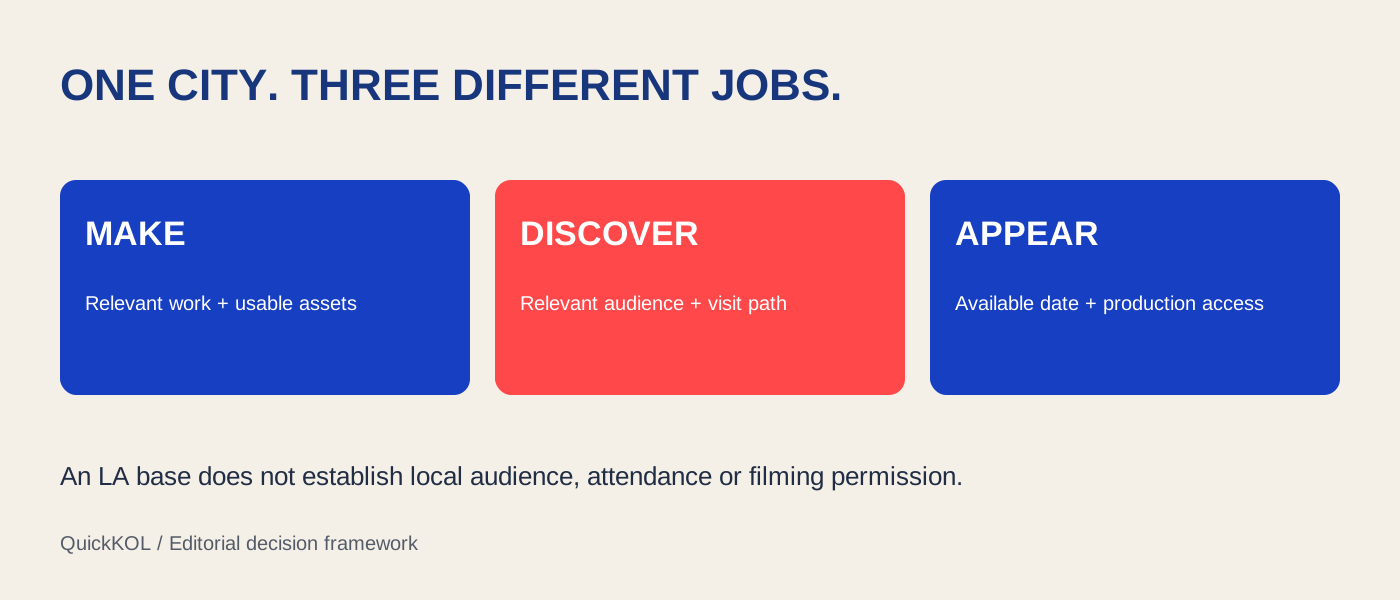
Choose the kind of LA partnership you need
If your product sells nationally, Los Angeles may simply be the production setting. Demonstration skill and usable asset rights can matter more than local followers. A neighborhood business instead needs relevant customer discovery and an experience it can actually deliver. An event host also needs a confirmed date, on-site role and workable participant arrangements.
Use the local-creator research guide to write one sentence: who should understand what, and what should they do next? Do not send find an LA influencer to the team and let account size become the default decision rule. These jobs can be purchased together, but each needs its own evidence. A strong video producer is not automatically a local distribution partner, and a locally recognized personality is not automatically available to host your event.
Two official starting points: explanation and design-led lifestyle
Sohee Carpenter’s official introduction identifies a Los Angeles base and work around fitness and behavior explanation. Start there to establish identity and examine current relevant work. For specialist assignments, verify the scope you actually need; a biography does not endorse any health claim a brand might want to make.
Oh Joy! identifies its studio as Los Angeles-based and describes Joy Cho’s design, lifestyle and brand-partnership work. It offers a different research route for design-led storytelling and product collaboration. Existing licensed-product work does not mean every new brand can buy the same arrangement, and a social post differs from a co-designed collection. These are two supported entry points, not a ranking or a bookable roster. Neither source confirms current fees, follower counts or acceptance of your particular brief.
Separate three meanings of local
Keep three fields. Operating context describes the creator’s public location connection and actual project availability. Content geography describes whether relevant work explains a local situation rather than merely showing a palm tree or landmark. Audience geography describes the people the channel reaches, under a stated source and window.
These fields are not interchangeable. An LA-based creator may have a national audience; a visitor may be an excellent producer for a specific assignment. If evidence only supports a US audience, retain that precision instead of relabeling it Los Angeles. Do not infer identity from appearance, accent or live whereabouts. Record the source, date and unresolved state. A specific evidence gap helps the next researcher act; a broad local=yes label hides which question was answered and which was never investigated.
Search for demonstrated work before popularity
Combine the product task, setting and format: an LA small-space organization demonstration or a first-visit store walkthrough, for example. Save relevant public work, then use owner-controlled sources to locate the current account and business route. Exclude fan pages, reposts and unrelated namesakes before consolidating identities.
The creator-shortlist workflow preserves the task rationale, work link, location evidence, contact route and unresolved items. Start with a few genuinely relevant candidates, then assess whether size matters to this purchase. If results do not fit, revise the query or task instead of repeatedly loosening conditions until a famous person appears eligible. The shortlist exists to support a specific conversation, not demonstrate how many profiles a researcher can export.
Check the actual shoot location and requirements
LA is a project description, not one uniform permitting jurisdiction. FilmLA’s official guidance explains that requirements are set by the jurisdictions it serves and directs projects to clarify their actual filming plans. A phone does not automatically make commercial filming personal use. Do not assume one deadline or fee applies everywhere.
Give the responsible party the actual address, controlling authority, equipment, people, timing and commercial purpose to check. Property-owner consent and other applicable permission conditions need separate attention. Renting a private storefront does not, on its own, establish that every commercial condition is satisfied. Confirm ownership of the task, resolved dependencies and decision timing before the brand relies on the shoot. This is a planning route, not a permit determination for a particular production.
A hypothetical pilot: turn the setting into explanation
Suppose a lifestyle brand needs a tote demonstration for national sales. A first commission could cover genuine packing, one store-preparation scene and one consolidated review round. It need not purchase local follower distribution. Acceptance can inspect whether the relevant items are shown, product facts are accurate and files meet the agreed specification.
If the brand instead needs store visits, define opening information, booking conditions, available products and the viewer’s next step, plus the local-audience evidence required. These are different purchases, not one brief with a city name swapped into the opening. The example assumes no market price or guaranteed orders. It shows how to reduce scope around the objective before discussing a quote.
Separate the fee, disclosure and permitted use
Discuss production, account publication, brand use, revisions and expenses separately. Identify assets, channels, territory, period and any paid-media permission. Publication on the creator’s account does not automatically grant permanent brand advertising use. The statement-of-work template helps capture the fields before the parties confirm the actual terms.
FTC guidance explains disclosure of material relationships, including payment and free or discounted products. Do not hide the relationship in a biography or vague label because the creative resembles an ordinary LA experience. Personal experience must also be truthful; do not require a claim of long-term use that did not occur. Review facts, experience and disclosure as distinct questions rather than introduce unagreed commercial obligations during the final approval round.
Measure the purchased job before expanding
For a production purchase, evaluate usable delivery, factual accuracy and permission. For distribution, preserve defined view or reach observations. For a store campaign, inspect booking or visit relationships and their collection window. Views are not new customers, and a campaign code does not automatically establish incremental demand.
The reporting-decision guide separates observation, interpretation and next action. QuickKOL can assist brief understanding, relevant-work discovery and personalized contact preparation. Audience geography, quotes, timing and permissions still need confirmation. A renewal should name the next product question to answer rather than assume that filming in Los Angeles means the brand has entered the local market.
A copyable first inquiry
Adapt this inquiry: Hello [name], we are [brand]. Your [specific work] explains [question] clearly. We would like to commission [one deliverable] during [date window] to help [audience] understand [supported product question]. The proposed setting is [location, subject to confirmation]. Would you be interested in discussing the task? Please share the scope, fee and timing you would propose for production, publication and [specified use and period], plus any location dependencies. We can supply [product facts and materials]. We would confirm scope and disclosure arrangements before work starts.
This is an inquiry, not an accepted agreement. Keep unresolved dates or budget conditions explicit, and request only information relevant to deciding the next step.
Must the creator live in LA?
Not necessarily. Production may require relevant capability and a workable setting; an appearance requires confirmed attendance; local acquisition needs audience evidence. Define what local means for the task instead of imposing a residence condition unrelated to the purchase. The two named entry points are not an exhaustive list. Extend research under the same fields, retaining unknown counts, fees and availability until supported.
Research date, evidence and limitations
Sources reviewed October 28, 2026. Official entry points support identity and work research, not live rankings, quotes or booking promises. Workflows are editorial recommendations; the pilot is hypothetical.
Compare three LA creator assignments
Editorial analysis and labeled hypothetical examples, not performance rankings, quotes or guarantees.
| Purchase objective | Primary evidence | Do not assume |
|---|---|---|
| Content production | Demonstration work, specifications and permission | A local setting means local viewers |
| Store discovery | Relevant audience and deliverable experience | Views equal visits |
| In-person contribution | Date, role, setting and permissions | A city biography means availability |
CHECKLIST
Before you put this into practice
Record the answers in the campaign working file.
- Define one primary job
- Separate operating, content and audience geography
- Verify official identity and work
- Confirm location, date, fee, disclosure and permission
Sources and further reading
External pages can change. Recheck platform rules, contracts and local law before launch.