
THE SHORT ANSWER
A useful influencer negotiation model records deliverables, publication, rights and expenses rather than inventing a fair fee from follower count. Normalize the quote, calculate the gap to the approved budget and propose a specific change in scope or terms. Keep each version so the creator can see what changed. The model supports a clear counteroffer; it cannot predict acceptance, establish a universal market price or convert an estimated audience metric into a binding commercial entitlement.
Keep quote versions
Create a quote identifier, currency, tax treatment, validity date, contact and version timestamp. Preserve the original file separately from your working model. Repeatedly overwriting a single total makes it difficult to know which proposal the team approved or whether a later email changed the scope. A version is a commercial record, not administrative decoration.
Payment timing, scheduling and tax treatment can also change comparability. The quote-normalization guide helps establish consistent fields before discussing a discount. Two proposals with the same headline total may include different obligations, revision limits or expense assumptions. Record unknown items explicitly and ask about them together. This avoids presenting a counteroffer based on a cheaper-looking package that only becomes more expensive once the missing requirements are added back.
Separate four negotiable components
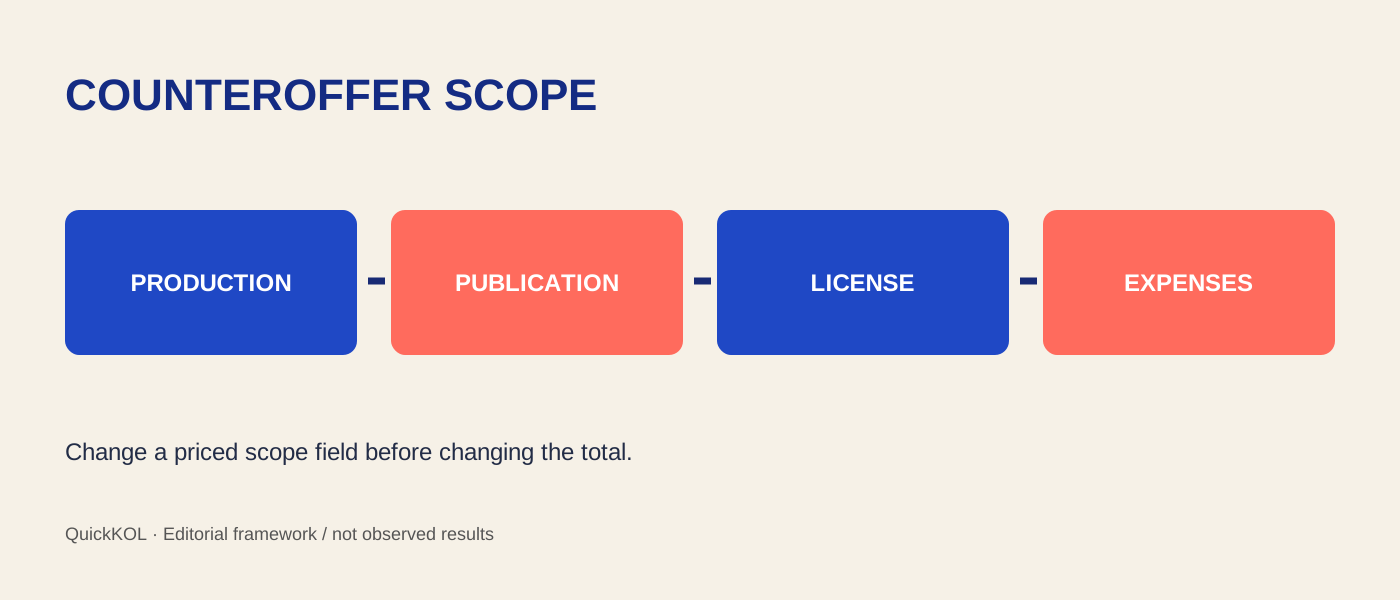
Use four commercial components: production, publication, licensing and expenses. Production covers the agreed creative work. Publication names the account, platform and posting window. Licensing describes permitted media, territory, term and edits. Expenses cover agreed travel or other reimbursable items. A creator may quote a bundle; preserve it as a bundle when necessary and clarify its boundaries.
The brand does not need access to the creator’s private cost structure or profit margin. It needs a clear relationship between the purchased scope and the quoted amount. Do not force an artificial hourly breakdown when the offer is priced as a creative package. Instead, ask which optional uses or deliverables can be removed and whether that would change the quote. Commercial clarity should make the negotiation easier for both parties, not turn the spreadsheet into a demand for confidential business information.
Define the working schema
A compact schema can include line_id, asset_id, scope_type, quantity, version, price_status and a related rights record. Price status might be quoted, pending or included in a bundle. Do not use zero to mean all three. Keep counteroffer versions in a separate record linked to the original quote, with an explanation of each changed field.
For rights, record the start and end conditions, publishing identities and paid-media use. The U.S. Copyright Office describes the exclusive rights associated with copyright; a project still needs its own agreed license scope. The rights guide explains practical scheduling fields. Your model should make it possible to answer which asset may be used where and until when. A total called usage fee is insufficient if no one can reconstruct the corresponding permission.
Worked example: turn a gap into an option
Consider an invented quote of $600 for production, $250 for publication, $300 for a ninety-day advertising license and $50 in expenses. The total is $1,200. Against an approved budget of $950, the gap is $250. These are hypothetical inputs, not market rates or an example of a creator’s actual offer.
Instead of demanding an unexplained percentage discount, ask whether the creator would consider production, publication and expenses for $900, with advertising rights negotiated later. The remaining $50 is uncommitted budget, not permission to extend the license. The creator may decline unbundling or return a different package. Recalculate from the revised offer rather than assuming every removed line reduces the total dollar for dollar. The arithmetic explains an option; it does not create an obligation to accept it.
Use evidence without promising results
Use work samples, production complexity and documented execution history to understand the assignment. Predicted views do not guarantee sales and do not automatically justify a particular discount. If historical performance informs the discussion, retain the sample, reporting window and whether distribution included paid support. Keep an estimate visibly separate from a contractual deliverable.
Compare concrete alternatives: fewer assets, a shorter license or a more flexible schedule. Explain what the brand loses under each option. A reduced budget is not costless when it removes a format needed for the campaign or delays a seasonal launch. Similarly, an earlier payment may have value to the creator without changing the work. Ask whether a proposed tradeoff is useful rather than assigning a spreadsheet-generated monetary value to every preference and presenting that value as an established fact.
Write an answerable counteroffer
Start the message by confirming the work you want and the scope of the quote you received. State the actual budget constraint and one preferred option. For example: “We can approve up to $950. Would you consider one organically published video without paid-media rights? If that scope is workable, please send a revised quote.” This asks a clear question without pretending the existing offer has already been discounted.
Do not invent competing offers or imply guaranteed future work to pressure an agreement. If no viable scope fits, close the discussion respectfully. Preserve the creator’s response in the version record and update the status to accepted, revised or declined. The counteroffer should reduce ambiguity. A long message containing several unlabeled budgets, optional rights and vague future opportunities often creates more work than a straightforward commercial disagreement.
Check the final obligations
Before approval, reconcile the accepted version with the agreement, purchase order and production card. The creator should see the same deliverable count that production expects, while media buyers see the same license term that finance paid for. A later extension needs a new recorded version rather than an informal assumption that the original negotiation covered it.
Use the quote-normalization guide and rights guide to retain the original offer, the reason for the counteroffer, the creator’s confirmation and the final scope. Add an owner for renewal and for stopping use at expiry. The finished model should explain a decision without reconstructing the conversation from memory. It is successful when both sides can point to the same obligations, not when an algorithm labels one side’s preferred price as objectively correct.
What if the creator only offers a bundle?
Keep the bundle intact and ask whether a smaller package exists. Do not assign invented internal prices to its components. If no workable offer fits the budget, close this purchase. A clear commercial disagreement does not require declaring the creator unreasonable or pretending the spreadsheet has established an objective price the other party must accept.
Research date, evidence and limitations
Sources reviewed October 23, 2026. Workflows are editorial recommendations. All worked examples are hypothetical, not client results, creator rankings or quotations.
A decision sheet for this assignment
Editorial analysis and labeled hypothetical examples, not performance rankings, quotes or guarantees.
| Condition | Evidence | Decision |
|---|---|---|
| Original quote | Hypothetical $1,200 | Preserve full scope |
| Budget gap | 1,200 − 950 = 250 | Identify optional obligations |
| Proposed option | $900 scope without advertising license | Request a revised quote |
CHECKLIST
Before you put this into practice
Record the answers in the campaign working file.
- Version the quote
- Respect bundled pricing
- Tie offers to scope
- Own license expiry
Sources and further reading
External pages can change. Recheck platform rules, contracts and local law before launch.