
THE SHORT ANSWER
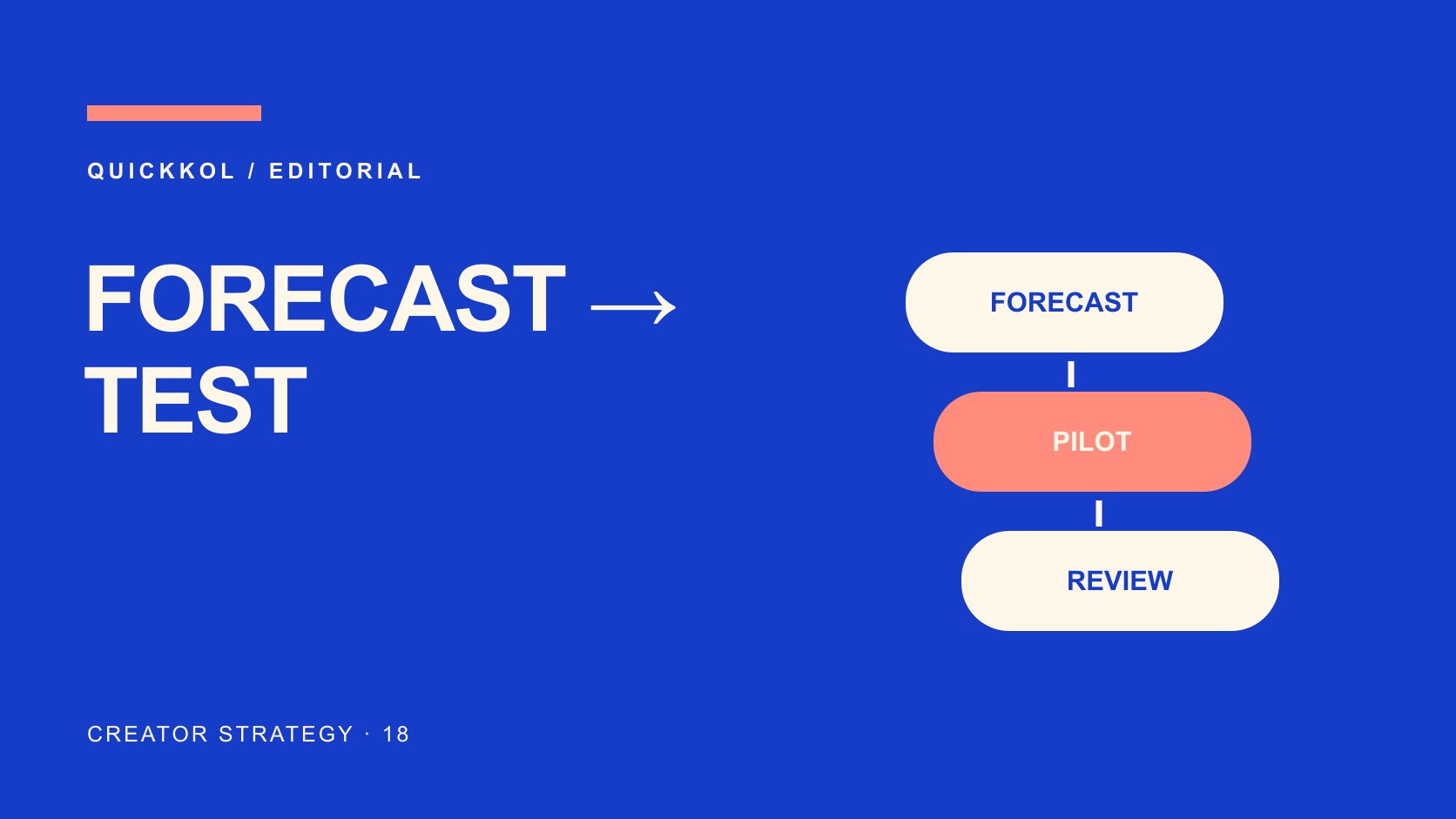
Read influencer marketing trends by evidence type. A market forecast describes expectations, a buyer survey describes reported intentions and a brand test addresses a specific operating question. IAB’s 2025 report expected US creator advertising spend to reach $44 billion in 2026; that is not a final actual result for the year. Convert the implication into a small, reversible test rather than let a trend headline decide the software, creator roster or rights package you buy.
Read date, geography and population
IAB published its report in November 2025 and projected $37 billion in US creator advertising spend for 2025, alongside its expectation for 2026. These figures should not become a global market estimate or be rewritten as completed 2026 spending. Preserve the date, geography and wording of the source.
Market growth can justify attention without deciding your allocation. It does not show that your product should immediately increase spend or that a particular creative format will work. The platform-selection guide helps connect broad market interest with a specific operating need. Before using a statistic in an internal proposal, write the claim it can actually support. A correctly scoped forecast is more useful than a larger-sounding number that has lost its time frame and population.
Turn measurement interest into an acceptance test
The same IAB report identifies measurement and standards as improvement areas. A brand can translate that into an acceptance question: can the system trace an asset to its metric source, reporting window and associated order? The implication is a testable requirement, not an instruction to purchase another dashboard.
The analytics-acceptance guide develops that exercise. Market research explains why a question deserves attention; a product demonstration supplies evidence of how a particular system behaves. Keep those roles separate. Test a duplicate order, an unavailable post and a revised observation. If the current process already handles them adequately at the required scale, the trend does not by itself justify replacing it. A useful change with a named decision owner should address an observed weakness and preserve the evidence needed to assess whether the new route is better.
Test AI research for traceability
Do not equate using AI with having improved efficiency. Choose a real brief without sensitive information and compare candidate reasons, work sources, identity errors and correction time. More output is not necessarily usable output. Define what a teammate must be able to inspect before adopting the result.
QuickKOL can support brief interpretation, creator discovery, content understanding and outreach preparation. Current audience evidence, prices and commercial willingness still need source verification. A fluent explanation does not establish that research is complete. Keep a small error log and ask whether the tool helps the reviewer correct mistakes or merely produces another confident version. This evaluates a practical contribution without claiming a general productivity gain from an internal test that covers only one category, language or workflow.
Test content reuse against the license
A brand may want the same creative work for organic publication, a website and paid advertising. Check those uses individually rather than demand permanent all-media rights because reuse appears in a trend discussion. Identify the actual versions and term the campaign can use now. An expansive license is not automatically an efficient purchase.
The usage-rights guide helps record the scope. A small test can buy one defined use, assess suitability and then discuss renewal. That makes both the brand’s failure cost and the creator’s opportunity cost more visible. Keep the final asset, permitted edits and stopping date together. If the creative does not suit the intended placement, learn from that result instead of assuming broader rights would have solved the underlying format or product-explanation problem.
Test the ability to support relationships
Longer relationships can sound attractive, but they require current records, timely payment, issue handling and rights maintenance. Check how many people the team can actually support before calling an exported roster a community. Relationship language should correspond to operating capacity rather than disguise a one-off transaction.
Test continuity across two rounds of a comparable assignment. Does the second round require less explanation of scope, delivery and communication? Preserve the work conditions so the comparison is interpretable. Faster replies do not automatically establish greater consumer trust; that is a different outcome. A relationship pilot can still be useful when it demonstrates smoother collaboration without making a market-wide claim. The ambassador-enablement guide offers a related way to examine whether participants have the materials and support needed to represent the brand accurately.
Worked example: choose one test from three trends
Imagine a team interested in AI discovery, paid creative reuse and an ongoing ambassador program. Ask which addresses the current bottleneck. If candidate research is delayed, test research quality on one brief before changing pricing, assets and media distribution at the same time. A narrower test is easier to interpret.
Define a stopping condition, such as identity errors that cannot be corrected or output that cannot be traced to work evidence. The evaluation may focus on task quality and measured human effort rather than force an immediate sales ROI calculation. These are hypothetical operating choices. Keep the test budget and decision date explicit. A trend-informed experiment should produce a decision to continue, revise or stop, not become an open-ended project justified indefinitely by the fact that the category is growing.
Maintain an evidence update rhythm
Label each trend record as observed evidence, forecast, vendor statement or editorial inference. Review it according to the likelihood of change. Prices and platform permissions need more frequent checks than basic workflow definitions. When a source changes, update the interpretation as well as the citation date.
Use the analytics-acceptance guide, platform-selection guide and usage-rights guide to turn research into a next action. A useful trends article helps readers ask better questions and design proportionate tests. It should not use a year in the headline to imply inevitability. The practical outcome is an operating decision supported by a dated record: why this change was tested, what happened and what evidence would justify doing more.
Should budget rise with market growth?
Not mechanically. A market forecast does not measure your brand’s marginal return. Review the current assignment, creative supply, operating capacity and measurement quality before deciding what additional spend would accomplish. Preserve a test and stopping condition. Growing investment elsewhere can motivate investigation without becoming a formula for your own budget.
Research date, evidence and limitations
Sources reviewed October 23, 2026. Workflows are editorial recommendations. All worked examples are hypothetical, not client results, creator rankings or quotations.
A decision sheet for this assignment
Editorial analysis and labeled hypothetical examples, not performance rankings, quotes or guarantees.
| Condition | Evidence | Decision |
|---|---|---|
| Market forecast | Expectation, date and geography | Frame a research question |
| Product demonstration | Actual test inputs and outputs | Assess task support |
| Brand pilot | Conditions, costs and stopping rule | Continue or revise |
CHECKLIST
Before you put this into practice
Record the answers in the campaign working file.
- Do not rename forecasts as actuals
- Test one key change
- Record correction effort
- Make a dated continue-or-stop decision
Sources and further reading
- 01IAB
External pages can change. Recheck platform rules, contracts and local law before launch.