
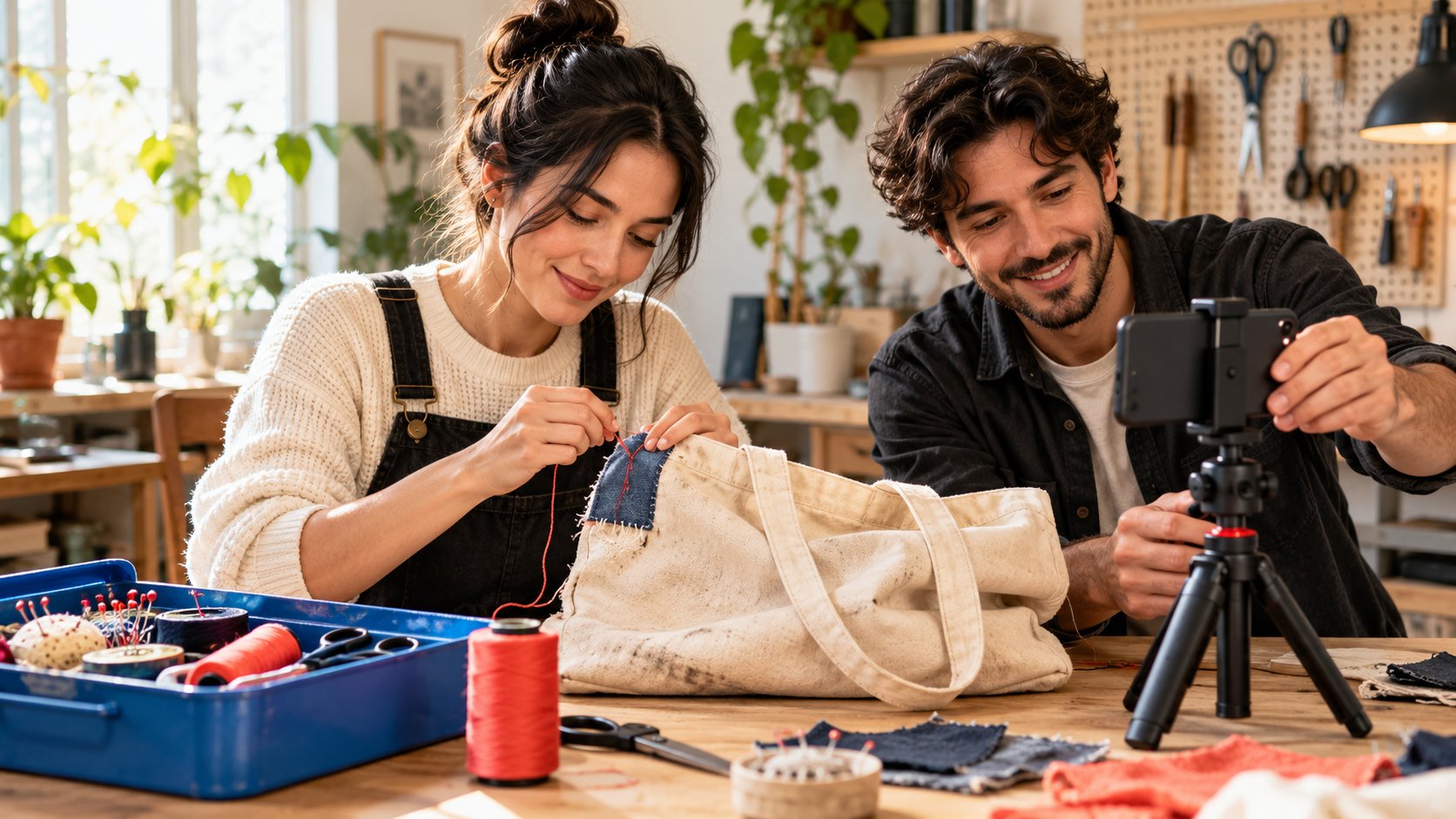
AI-generated editorial illustration, not an actual creator, client, product or event.
THE SHORT ANSWER
When researching top eco-friendly influencers, define the repair, maintenance or reuse task first and inspect relevant work and evidence. Kathryn Kellogg, Aja Barber and The Sorry Girls offer different first-party research routes, not a live ranking, environmental certification or accepted-partner list. A repair process can show what happened without independently proving an overall greener product or quantified emissions savings.
Start with an achievable action
Eco-friendly influencer is a research label, not a complete assignment. A brand might commission maintenance of an existing item, a suitable repair demonstration or a discussion of when replacement is unnecessary. Define the object, situation and completion condition before selecting the creator. Personal identity should not become green endorsement of an entire product line.
The environmental claims and creator-fit guide supports initial evaluation. This article focuses on process evidence: the item’s starting condition, the action taken and the conclusion it supports. Separate production, opinion and environmental benefits so a useful demonstration does not become a presumed life-cycle study.
An item may be repairable, need professional assessment or be unsuitable for continued use. Scope follows the actual conditions, without requiring every case to succeed. Identify work for appropriate specialists and the explanation the creator performs. An accurate limitation is more transferable than a promise that every old object can be renewed. The brand should be able to state what the audience will learn even if the practical outcome is to stop, seek another service or choose a different method instead of completing the originally imagined repair.
Kathryn Kellogg: study practical lifestyle explanation
The Kathryn Kellogg official profile provides context about the founder of Going Zero Waste and lifestyle education. It is a route into practical explanation, not causal evidence from personal health stories or current platform verification from self-described influence. Audience, timing and commercial conditions need separate confirmation.
Inspect relevant public material for how an action becomes understandable steps, which existing items it requires and what conditions a newcomer might misunderstand. For maintenance, replenishment or avoiding unnecessary replacement, these questions are closer to the assignment than a green appearance. The brand still verifies the particular product’s suitable use.
A similar creator can receive accurate instructions, service scope and relevant limitations without being asked to guarantee savings or identical environmental results for everybody. A lifestyle suggestion may apply under particular conditions; an advertising extract should not make it universal. Connect work with the task rather than substituting a recognizable name for product evidence. The invitation should leave room for the person to explain that the proposed item or habit does not fit the situation, since credible education depends on choices rather than compulsory inclusion of every supplied product.
Aja Barber: study consumption and necessity
The Aja Barber official profile provides public context for fashion, writing, styling and sustainability-related consulting. It supports research into why people buy, retain or stop using something. It does not establish endorsement of a product or availability to every brand. Historical pages do not supply current quotes or dates.
A consumption-focused role needs room for the question of whether a new object is needed. Maintenance, repair or service content may not end solely with selling more new products. Define a genuine task the business can accept before assessing fit. Do not research public viewpoints and then require a conclusion contrary to that direction.
Retain work, questions and editorial observations. Consumption storytelling does not quantify a particular product’s impact or establish that every reuse is environmentally preferable. Comparisons need an appropriate scope and evidence. The named entry helps research a way of discussing choices, not assemble a most sustainable creator ranking without a method. A clear invitation can explain the decision the audience faces while preserving the possibility that a useful answer includes buying less, seeking repair or declining the proposed product rather than endorsing it.
The Sorry Girls: study making and repair processes
The Sorry Girls official profile describes DIY, interior design and education. It supports studying how making becomes understandable content, not a claim that every work has an environmental-impact assessment or that the team can perform any repair anywhere. Verify relevant capability and execution conditions separately.
Inspect how materials, tools, steps and reasons appear in public work. A repair needs the starting condition, intervention and result, not only before-and-after photographs. Work with professional requirements or conditions unsuitable for ordinary imitation needs appropriate people and accurate explanation. A fast edit does not establish that the actual task takes only minutes.
A similar role can show maintenance and reuse while preserving the difference between completing a project and proving an overall environmental improvement. Separate content, execution, samples and usage in the invitation. Provide an exit for an unsuccessful or unsuitable item instead of concealing limits to complete a sponsorship narrative. A useful process lets viewers identify what they still need to verify. The brand’s record should also identify which practical work the creator performs and which responsibilities belong to a supplier, specialist or location operator.
Record the condition, action and outcome
Choose a real object and retain its initial condition, relevant use history, instructions and feasible scope. Collect only necessary information, not unrelated private details. Confirm who supplies material, who assesses suitability and how an unsuitable task changes or ends.
The creator work-scope guide helps organize making, filming and later observation. Show what happened, which steps were not shown and how long the result was observed. Keep records of replaced parts or added material instead of editing the intervention to look like simple cleaning.
Restoring a function over a short period supports that particular observation. Without longer evidence, do not promise years of remaining use or permanent durability. Hypothetically, a patched tote carrying the objects in a demonstration would not verify every load or an environmental benefit. Label the illustration as hypothetical; real projects return to actual actions and results. This record gives the editor a defensible explanation even when the repair is partial, and makes it possible to distinguish a completed process from an unsupported claim about future performance or avoided replacement.
Make environmental claims more specific than the story
ACCC environmental claims guidance emphasizes truthful, accurate presentation in Australia, considering omissions, imagery and overall impression. A leaf backdrop or repair sequence may imply benefits beyond the words. Review the actual work instead of searching the script for a few terms. This article does not determine the legal position of a particular project.
The FTC Green Guides summary, in the US context, advises against broad unqualified green or eco-friendly benefit claims and calls for clear specific qualifications. It is not a labeling permission that applies unchanged across markets. Material reduction, extended use or superiority over an alternative needs evidence matching the wording, object and comparison boundary.
Put the repair action and environmental conclusion in separate fields. Without suitable assessment, explain what was repaired, replaced and still limited rather than inventing emissions, waste or resource-saving numbers. A lifestyle, professional image or public trust cannot convert an unknown product impact into a verified fact. Keep the necessary qualification prominent in the final image or extract, since a detailed source document elsewhere may not repair a stronger impression created by the asset itself.
Include relationships, editing and updates in scope
Record fees, materials, samples and other support, and arrange a clear explanation of the relationship in the actual publication. Check platform and market conditions for the project. Receipt of an object does not automatically confirm every commercial, asset and promotional purpose.
Version review should preserve the original item, intervention, observation period and claim conditions. An extract removing in this demonstration can turn a limited observation into a general promise. Check translations and captions too. Specify advertising, regional-partner and owned-site use with channels, term and permitted edits.
Assign correction, replacement and expiry ownership when later use changes. A long-term update can be discussed as another task instead of assuming perpetual maintenance belongs to the initial production. Retain uncertainty, unsuccessful cases and revised scope so another colleague understands the evidence boundary. That prevents a repair story from becoming comprehensive endorsement through repeated reuse. It also makes commercial handoff clearer: the next recipient can identify which version is ready for the intended placement and which request requires another factual review, permission or actual observation before proceeding.
Choose the role through a concrete assignment
Suppose a fabric-repair service wants to explain how to judge whether an old bag is suitable for repair. Lifestyle explanation can address everyday choices, consumption discussion can question replacement, and a process role can demonstrate appropriate work. This hypothetical scenario does not indicate acceptance by the named references or repairability of every bag.
Prepare service boundaries, a demonstrable object, facts and failure or stop conditions before researching work. The brand can choose one role or divide tasks without asking the most recognized person to do everything. Without an environmental assessment, do not package the process as emissions research.
Hand over the task, evidence, actual outcome, versions and next decision. Continue an explanation, revise service information or stop an unsuitable demonstration. Translate top into task fit. Named routes are a starting point, while current commercial conditions still need verification. Citable material comes from a clear method and scope rather than an unsupported green ranking. The record should allow a colleague to distinguish the useful action shown from the larger environmental question that the project may not be equipped to answer.
Research date and limitations
Initial research was conducted October 29, 2026, with additional verification October 30. Methods, examples and tables are editorial recommendations; hypothetical numbers are not industry benchmarks. Named entries support research, not live rankings, endorsements, availability or acceptance. Interfaces and data depend on accounts, permissions and versions. Some Meta help pages could not be fully retrieved, so unverified button paths and fixed thresholds were excluded.
Repair and reuse evidence matrix
Named creators are research entries, not environmental certification or a live ranking.
| Layer | Record | Do not automatically infer |
|---|---|---|
| Action explanation | Object, steps and conditions | Everyone can complete it |
| Outcome observation | Actual change and observation period | Long-term performance guarantee |
| Environmental benefit | Matching assessment, scope and comparison | One repair proves an overall greener product |
| Reuse of content | Versions, limits, uses and term | Original permission covers every later use |
CHECKLIST
Repair content preparation
Separate demonstrable actions from benefits needing proof.
- Define the object, operation and stop conditions.
- Research relevant work by role.
- Record actual condition, intervention and period.
- Match environmental claims with evidence and market scope.
- Review images, captions and overall impression.
- Hand over relationships, permissions, versions and next action.
Sources and further reading
- 01Going Zero Waste: About Kathryn
- 02Aja Barber: Writing, styling and consulting
- 03The Sorry Girls: About Us
- 04ACCC: Environmental and sustainability claims
- 05FTC: Environmental Claims Summary
External pages can change. Recheck platform rules, contracts and local law before launch.