
THE SHORT ANSWER
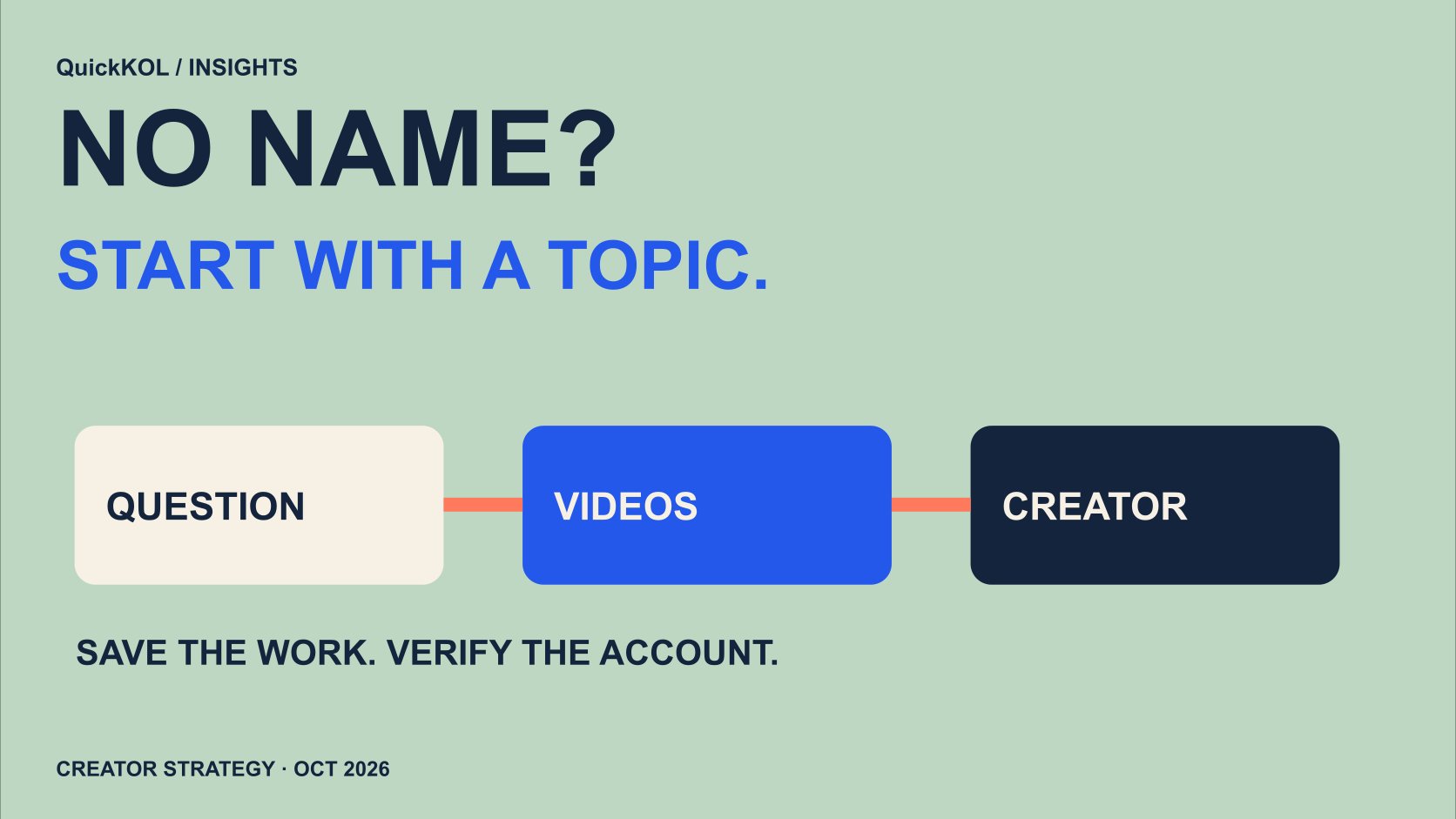
When you do not know the creator’s name, a TikTok finder should help turn a customer question into content searches and then into a candidate pool. Start with the problem, inspect relevant videos and verify whether the account repeatedly produces suitable work. Preserve queries, URLs and dates. Finding a known username is a different task covered in the account-search guide; this article focuses on discovery from topics and recurring creative formats.
Translate the brief into customer language
List the product job, use situation and question a viewer might ask. A storage tool can appear in moving, rental, dormitory and decluttering-failure content, not just videos labeled with its retail category. Write several query routes that correspond to real customer situations instead of copying the brand’s internal vocabulary into every search.
Separate hard constraints from exploration preferences. A supported shipping market may be essential, while a minimalist visual style may be optional. Applying every preference immediately can hide useful explanatory work. The brief-to-candidates guide helps establish this distinction. Search should explore plausible ways the assignment could work before a reviewer narrows the pool to the formats and conditions the brand can actually purchase.
Search the topic and the format
Combine a subject with a content format: rental storage plus before-and-after, common mistakes or step-by-step explanation. A sound or popular tag can be an entry point into videos, but it is not evidence of category expertise. The same audio may appear in many unrelated contexts.
Inspect what the video actually communicates before promoting the account into the candidate pool. Does the person explain a constraint, demonstrate a process or merely mention the product category? Record the observed behavior rather than a vague relevance score. This approach keeps discovery connected to the customer question even when a search session surfaces highly entertaining material that would be difficult to adapt to the brand’s actual assignment.
Look for repeated capability
After a promising video, review a recent set of related work and any recurring series. Look for repeated explanation of the relevant problem, examples with different constraints and enough context to understand the production approach. A single viral clip may reflect an unusual event rather than a repeatable capability the brand can commission.
The account does not need to publish only one category. A creator can have several interests and still be a strong match. The question is whether enough relevant evidence exists for this assignment. Keep a few representative samples and state what each proves. The selection-beyond-followers guide provides a broader framework for turning those observations into a defensible shortlist rather than a collection of impressive screenshots.
Separate identity from fit
Relevant content does not establish that a contact route is authentic. Verify the complete account URL, username, official cross-links and public business route. Reposts, fan pages and similar names can appear beside the original work. Save the platform identity before adding contact details to the campaign file.
Link other channels only when evidence supports the relationship. Matching avatars alone are insufficient, and a public handle does not justify guessing a private email address. The account-search guide covers known-identity checks in more detail. Keeping identity verification separate from creative fit prevents a persuasive work sample from distracting the reviewer from the practical question of whether the brand is contacting the person who actually created it.
Verify audience and market separately
Filming in a city or speaking English does not prove that most viewers belong to the intended market. Keep location, language and audience geography as separate fields. When age bands or regional delivery matter, request appropriately scoped evidence and retain its date and limitations. Leave an unanswered condition unresolved rather than converting a visual impression into demographic data.
TikTok One’s official advertiser information provides a reference for a platform collaboration route. Its existence does not establish universal account coverage or suitability for a particular brief. Treat it as one route to investigate, alongside public work and authorized evidence. A candidate can be creatively relevant while still requiring a market check before the brand spends money or ships a product.
Keep a query log
Record the query, date, search route and reason for retaining each candidate. Search results can change; a log will not reproduce the same ranking forever. It will, however, explain how the team found a candidate and which assumptions shaped the initial pool. Save the original wording before replacing it with a broader interpretation.
Do not assume every tool interprets a filter identically. Modash’s search-optimization documentation distinguishes topics, biography keywords and hashtags. That vendor-specific distinction is a reminder to verify the behavior of the tool being used. It is not a claim that QuickKOL offers the same API or query syntax. Test one known example before relying on a filter to exclude a large portion of the market.
Worked example: narrow a video pool
Suppose a search produces thirty-six relevant videos from twenty-four distinct accounts. Ten have enough repeated work for review, six satisfy the verified market and commercial conditions, and four receive a scoped invitation. This is a hypothetical workflow, not a measured success rate for a discovery product.
Keep the reason for each reduction. If most candidates fail because samples cannot reach them, move logistics checking earlier. If most lack relevant work beyond the initial clip, refine the topic-format combination. Do not interpret every reduction as bad search quality; some are appropriate commercial decisions. A transparent funnel helps the team improve the actual bottleneck rather than increasing the number of saved videos without increasing usable candidates.
For sound-led discovery, save the original video as well as the audio route. Sharing an audio trend does not establish a shared specialty, and the brand should not copy a format before checking whether the creator’s actual explanation fits the assignment.
Validate a small pool before scaling
Ask a second reviewer to assess a small set before expanding discovery. They should be able to understand the content reason, verify the identity and identify the missing commercial evidence from the record. A usable shortlist is more valuable than a large saved-video folder that only its creator understands.
QuickKOL can help turn a brief into a discovery starting point, interpret content and prepare outreach. The brand still owns the final eligibility checks and offer. Scale once the queries, identity process and review handoff work together. Finding an account is an early milestone, not proof that a partnership is ready to sign. Preserving that distinction keeps the search practical and the next conversation honest.
Research date, evidence and limitations
Sources reviewed October 21–22, 2026. Workflows are editorial recommendations and numerical examples are hypothetical, not observed campaign results, creator rankings or offers.
The working sheet for this task
Editorial analysis and labeled hypothetical examples, not performance rankings, quotes or guarantees.
| Decision | Evidence to keep | Next action |
|---|---|---|
| Topic query | Video URL and question | Inspect the actual content |
| Repeated capability | Several relevant samples | Keep explainable candidates |
| Commercial eligibility | Sources and unknowns | Verify before inviting |
CHECKLIST
Before you put this into practice
Record the answers in the campaign working file.
- Keep the query log
- Separate virality and capability
- Verify identity before contact
- Infer no audience from scenery
Sources and further reading
External pages can change. Recheck platform rules, contracts and local law before launch.