
THE SHORT ANSWER
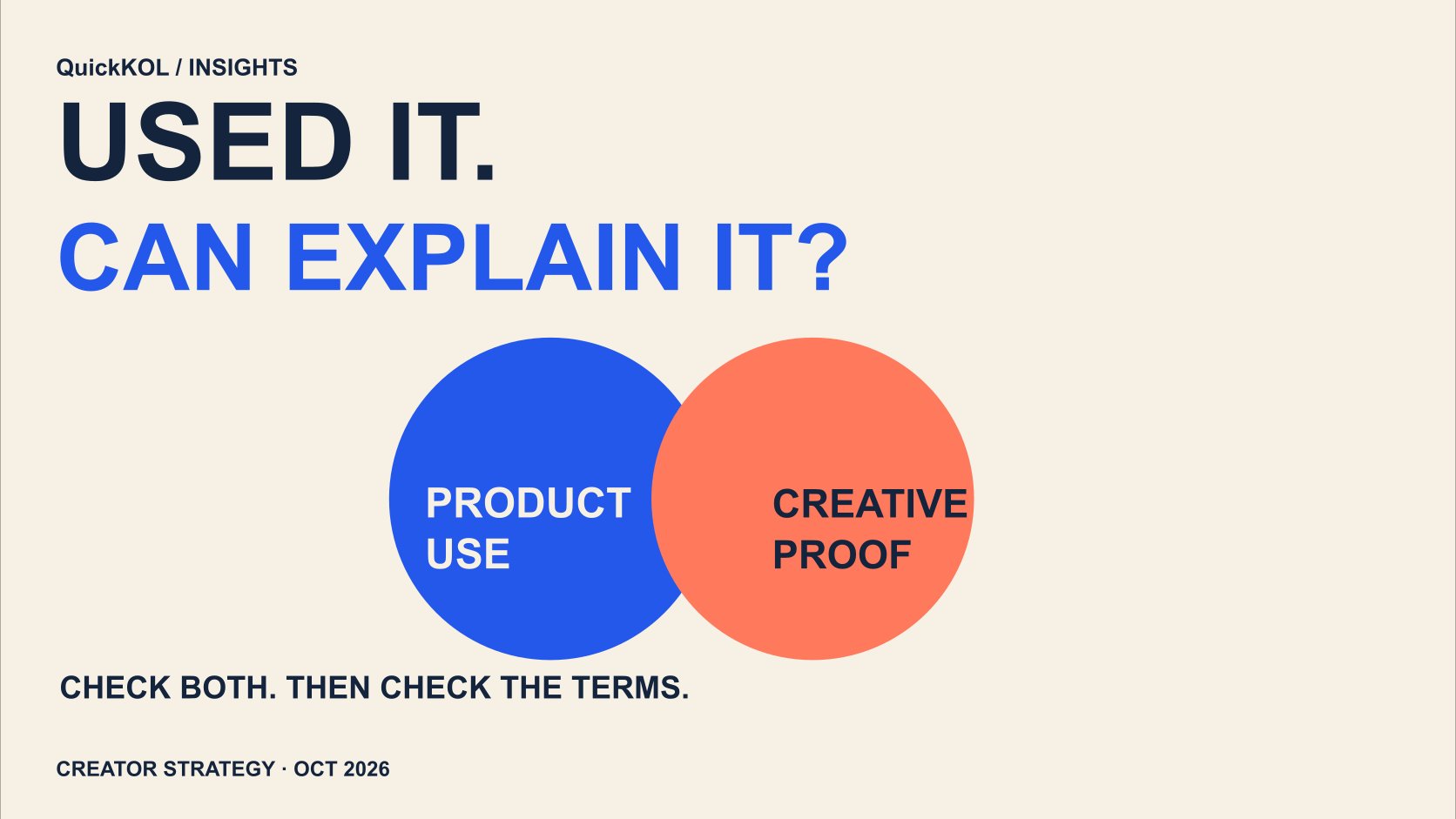
To find influencers for your brand, start with the customer problem and look for people who can credibly demonstrate the product in that situation. Voluntary customer participation and public product conversations can provide leads, while broader discovery fills gaps. Existing use is not proof of creative capability, and follower count is not proof of product fit. Verify those questions separately, then use a small scoped pilot before committing to a larger program.
Define the explanation your brand needs
Review recurring questions in customer service, product pages and sales feedback. Look for uncertainty about setup, compatibility or the situation in which the item is useful. Turn one question into a filmable assignment rather than beginning with an abstract request for more awareness.
A portable coffee device may need an office-cleaning demonstration rather than another scenic travel photograph. That decision changes which work samples matter. The useful-brief guide helps write the customer, constraint and desired explanation in one place. Keep a clear priority so the shortlist does not gradually expand into everyone who shares the category. A focused brief gives both the researcher and the creator something concrete to accept, challenge or refine.
Start with voluntary customer leads
A voluntary customer invitation can surface people who already understand the product. Explain that applying does not guarantee selection and let people choose which public channels or work samples to provide. Do not infer private social identities from order records. A purchase history belongs to a different operational context from a creator collaboration.
Public brand mentions can also provide leads, but verify the original content and account before adding them. Existing use reduces one uncertainty; it does not establish production quality, audience fit or willingness to accept commercial terms. Keep a separate application route and review criteria. The ambassador application guide discusses how to make that experience clear without turning ordinary customers into assumed promotional participants.
Evaluate use and communication separately
Assess whether the person can explain the product clearly, demonstrate its limits and address common questions. Someone who loves the item but has no relevant production experience may be valuable for a feedback interview rather than a published campaign. Someone with strong explanatory work but no prior product use may need a realistic testing period.
Do not reduce the decision to whether the candidate likes the brand. Ask the reviewer to identify the demonstration the person could perform and the evidence still missing. The creator selection guide helps distinguish complementary strengths. This separation also makes rejection fairer: an application can be unsuitable for one production task without implying that the customer’s experience or enthusiasm has little value to the business.
Use discovery to fill portfolio gaps
Existing users may cluster around one region, format or stage of the customer journey. Identify the missing capability before searching more broadly. A useful gap statement might be “English-language creators who can demonstrate cleaning in a compact workspace.” That is more actionable than asking for more people who look like the current shortlist.
QuickKOL can support brief interpretation, relevant discovery and content understanding. Human review still checks the candidate, work sample, contact route and commercial conflicts. The portfolio-gap guide explains how to connect new searches to what the existing mix lacks. Broad discovery is most productive when it fills a defined need rather than duplicating the same visual style because those accounts are easy to recognize.
Check market and product readiness
Confirm the supported sales market, shipping route, product version, required equipment and production time. A creator living in the target country does not prove that all viewers are there. Interest also does not establish availability this month. Keep each condition and its evidence in the candidate record.
An unresolved field can remain pending. Do not invent an audience percentage to make a spreadsheet appear complete. If the sample is not ready, adjust the project before promising a shoot date. Logistics and commercial readiness can disqualify an otherwise excellent creative match for this particular window. Recording that reason allows the relationship to remain useful for a later project rather than incorrectly labeling the candidate as a poor fit overall.
Offer terms that match the requested work
Being a customer does not give the brand free access to someone’s production work. If the assignment requires deliverables, revisions and a publication date, discuss compensation clearly. Gifts, commissions and production fees serve different purposes. A vague promise of perks does not describe an extensive commercial scope.
Use transparent terms that let the recipient decide whether the work is worthwhile. FTC disclosure guidance provides a US reference for material connections. Put responsibility for the relevant disclosure in the brief alongside the actual arrangement, then confirm it through the campaign workflow. The purpose is not to turn a customer relationship into a complex bureaucracy; it is to ensure that enthusiasm is not mistaken for acceptance of obligations the person never agreed to perform.
Worked example: design a decision-sized pilot
Suppose eighteen customers voluntarily apply, eight provide relevant work, five meet the shipping and timing conditions, and three receive small paid assignments. These numbers are hypothetical, not an expected customer-to-creator conversion rate. Keep the exclusion reasons so the next invitation can be clearer.
Define the decision the pilot must support. It might test whether a demonstration is understandable, whether the brief supplies enough information or which customer question remains unanswered. Do not change the product, price and destination page simultaneously and then attribute every difference to the creator. The campaign incrementality guide explains the stronger evidence needed for causal sales claims. A small pilot can still produce useful operational learning without pretending to establish a universal performance rule.
Preserve the relationship and the limits
At closeout, distinguish renewal, possible future contact and no fit for the current task. Handle payment and rights according to the agreement rather than withholding an accepted fee because distribution disappointed the team. Do not leave unsuccessful applicants waiting indefinitely for an implied offer. A brief honest status is more useful than an undefined promise.
The final shortlist should explain the content reason, actual use conditions, current state and next action. It is a working relationship record rather than an exported table of handles. Start with a small number the team can verify and support. Scaling becomes sensible when those records help the next person continue the work without guessing why a customer was approached or what the brand promised.
Research date, evidence and limitations
Sources reviewed October 21–22, 2026. Workflows are editorial recommendations and numerical examples are hypothetical, not observed campaign results, creator rankings or offers.
The working sheet for this task
Editorial analysis and labeled hypothetical examples, not performance rankings, quotes or guarantees.
| Decision | Evidence to keep | Next action |
|---|---|---|
| Product use | Voluntary experience | Check testing conditions |
| Creative capability | Relevant public work | Name the assignment |
| Execution readiness | Shipping, timing and scope | Run a small paid pilot |
CHECKLIST
Before you put this into practice
Record the answers in the campaign working file.
- Infer no private account from orders
- Separate use and capability
- Check current readiness
- Give applicants clear status
Sources and further reading
External pages can change. Recheck platform rules, contracts and local law before launch.