
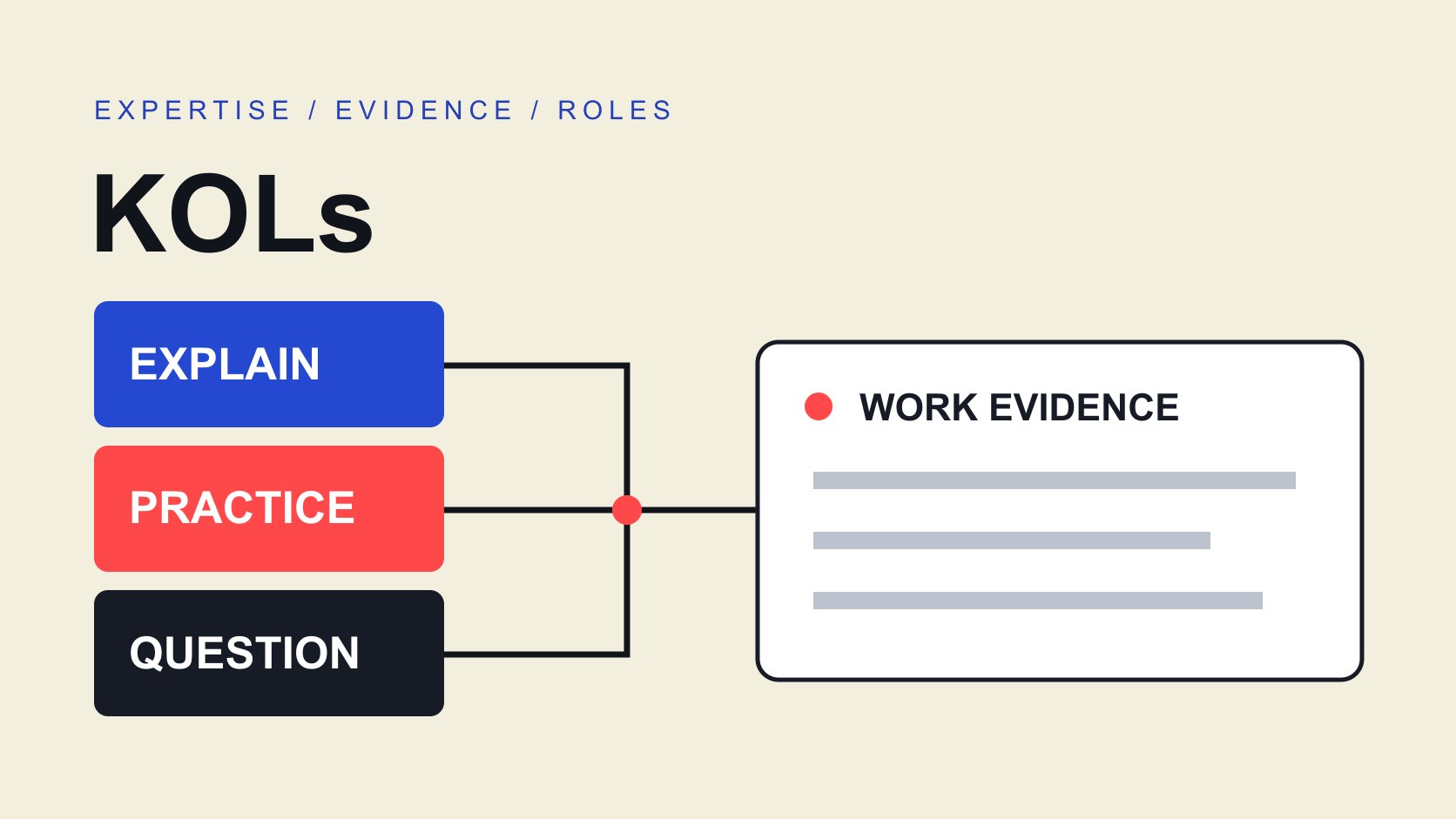
QuickKOL editorial graphic; not actual account metrics or a platform interface.
THE SHORT ANSWER
KOLs is the plural of key opinion leaders. For brand research, use it as a working description of people whose domain-specific views influence a relevant group, not a universal credential, platform certification or sales guarantee. Begin with the question the audience needs answered, then select complementary explainers, practitioners and questioners. One person may fill several roles, but each contribution still needs appropriate evidence.
Define the decision that needs better explanation
Do not begin with a request for five KOLs. Write down who needs to understand which question, and in what situation. A software buyer may need to understand how a migration preserves an existing workflow. A consumer may need to see cleaning and maintenance. Both assignments benefit from informed explanation without requiring the same person or audience size.
The AMA influencer marketing overview centers people who influence potential buyers and the organization of brand messages around them. That supports attention to audience and communication purpose; it supplies no universal KOL follower threshold. The roles in this article are an editorial planning method rather than an association-certified classification.
Express the desired understanding in a checkable sentence. A hypothetical assignment might require readers to identify three questions to ask a supplier before migration. Three is a project choice, not a benchmark. Also specify the boundary: explaining migration risks does not mean promising savings on every implementation. This framing gives the research team a useful reason to select expertise, rather than treating a prominent title as the answer to an undefined communication problem.
Assign distinct evidence roles
An explainer clarifies concepts, trade-offs and limits. A practitioner demonstrates steps and constraints from relevant work. A questioner identifies likely misunderstandings from the intended audience’s perspective. One contributor can perform all three functions; several people can share them. Avoid adding people simply to fill a diagram.
The creator content-role guide addresses content jobs across customer stages. An evidence panel asks a further question: who can support each part of the explanation? Keep relevant work, actual contribution and the reason for selection alongside the professional label. Operational experience does not establish authority over an entire industry, while a clear explanation does not prove that its author performed the task under discussion.
Imagine equipment training with a technical explainer, a permitted demonstration by an experienced user and a host asking beginner questions. This is a hypothetical design, not a client case. The brand remains responsible for product facts and applicable limits. Nobody in the group should be presented as independently certifying the whole production merely because they contributed to one portion of it. Clear attribution makes the different contributions useful without inflating their scope.
Collect work that supports the assigned role
Look for work addressing a similar question rather than collecting only the most popular posts. Record its address, date, subject, the contributor’s actual role and the capability it supports. A clear introductory video can support an explanation role without proving a professional qualification or knowledge of a newly released product.
The creator-shortlist workflow provides a place for these fields. When the assignment genuinely requires a credential or institutional connection, verify the relevant fact through an appropriate first-party public route and date that check. A past position in a biography is not automatically a current title. Matching names do not establish identity.
Initial screening should not become an unnecessary collection of private information. Use appropriate public business contacts and ask a specific question where decisive evidence is missing, such as whether a comparable public work can be shared. Unavailable examples remain unknown rather than proving incapacity. Distinguish observing a relevant explanation, receiving someone’s account of experience and independently checking a qualification. These are useful but different evidence states. Preserving the distinction helps the next colleague decide what still needs confirmation before an invitation becomes a commission.
Review a sample explanation against the actual question
Give candidates the same short description of the task and ask them to suggest an explanation sequence, required inputs and claims they would decline to make. An initial discussion can be brief. If selection requires a custom sample the brand could actually use, agree on scope and compensation before requesting production. Procurement should not quietly become unpaid creative work.
Review whether facts connect, terminology suits the audience and unknown conditions remain visible. Asking someone to identify a sentence that readers could misunderstand often reveals more than asking whether they are an expert. Willingness to read a supplied script does not establish that the explanation is reliable.
The expert interview brief helps organize questions, materials and approval. Explain whether contributors may state limitations or disagree with an assumption. A commercial relationship should not turn a conditional conclusion into an unconditional recommendation. If the brand cannot provide a test environment, specifications or necessary documents, resolve that input gap first. The creator’s reputation is not a replacement for missing product evidence. A useful sample discussion tests how the person reasons with available information and where further work would be needed.
Separate compensation, relationships and disclosure
State whether the brand is buying interview time, production, publication or another specific contribution. Sales-linked compensation, product access and a fixed fee are different arrangements. Calling someone a KOL does not remove the need to define the work. Relationships with another brand, employer or institution may also affect the proposed assignment.
In the United States advertising context, the FTC endorsement FAQ addresses honest, nonmisleading endorsements and appropriate disclosure of material connections. Expert status does not make a commercial relationship disappear. The operational recommendation here is to assign relationship checks, not to issue a legal finding about a particular person.
Record necessary questions and an owner without demanding unrelated private contracts. Check requirements for the actual market and platform. Carry the agreed disclosure approach through to the final asset and publication review instead of leaving it only in a payment email. Editorial review and commercial confirmation can have different owners, but someone must check whether the final version still expresses the agreed conditions accurately. This also prevents a researcher from mistaking an apparently independent public explanation for evidence of independence in a newly paid assignment.
Attach review decisions to an exact version
Save a version, date and reason for changes to scripts and assets. Mark product facts, personal experience and editorial explanation separately. A contributor who checked only their own portion should not be named as the reviewer of the whole article. Approval of a production date is not technical approval.
In a hypothetical software demonstration, the product owner checks feature conditions, the practitioner checks the steps they demonstrate and the editor checks that subtitles preserve the intended meaning. If the recording later changes to another version, the earlier confirmation does not automatically cover the replacement. Revisit the affected scope rather than mechanically asking everyone to approve everything again.
Assign one person to resolve conflicting feedback. When contributors disagree about a condition, establish whether they mean the same version and use case, then seek evidence, narrow the wording or pause publication. Job titles and follower counts are not a method for resolving factual disagreement. The handoff should let a later editor trace the conclusion back to the relevant material and see which parts were checked, by whom, under what conditions.
Distinguish participation from permission to reuse
Agreeing to an interview is not automatically agreement to unlimited advertising use. Confirm quotation, edits, captions, translation, channels, territory and duration, connecting the agreed scope to the relevant asset. An institutional name, third-party diagram or music can involve separate rights. An on-camera contributor may not be able to authorize every element.
The U.S. Copyright Office overview explains protection of original fixed expression and the general role of permissions, exceptions and limitations under United States law. It does not imply that every use requires the same document. For commercial uses that need agreement, retain the actual scope rather than treating possession of a file as permission.
A content licensing schedule connects the channel, version and expiry. Treat an additional use as a change to confirm rather than extending the original interview agreement to retail partners, advertising accounts or other markets by assumption. Assign responsibility for stopping use. The relationship can finish while assets remain distributed across teams, so the handoff needs enough information to identify what remains permitted and where an update or removal has to happen.
Review the contribution against the original task
Decide what to review before publishing. If the job is to remove a specific misunderstanding, record questions answered, remaining confusion and missing explanatory material. Views and interactions describe distribution, but do not independently establish comprehension or prove that a purchasing change came from one expert.
Suppose a hypothetical demonstration begins with six agreed questions. The finished asset addresses four clearly, while two remain open because inputs are missing. This describes coverage of that assignment, not a universal expert success rate. Keep unresolved items visible. Do not add every contributor’s followers and call the total unique reach.
The next decision might be to invite the same person again, add a complementary role, improve inputs or stop a content route. Connect that decision to work evidence and its limits. QuickKOL can help interpret the brief, discover relevant creators and research work and contact routes. Qualifications, contribution scope and commercial terms still need confirmation at an appropriate source. The goal is a defensible explanation with useful next steps, rather than an impressive roster whose contribution nobody can describe.
Research date and limitations
Sources reviewed October 30, 2026. Methods, tables and decision rules are editorial recommendations. Hypothetical examples are not actual client results or industry benchmarks. Source geography and periods are specified where relevant.
KOL evidence-role matrix
Editorial planning roles, not platform or professional certification.
| Role | Evidence needed | Does not establish |
|---|---|---|
| Explainer | Clear explanation of a similar question | Every domain qualification |
| Practitioner | Relevant work and actual contribution | Applicability to every product |
| Questioner | Understanding of audience questions | Statistical representation of the audience |
CHECKLIST
Evidence checks before invitation
Keep the minimum evidence needed for this assignment.
- Name the audience, question and explanation limits.
- Connect each role to relevant work and actual contribution.
- Separate titles, credentials, observations and self-reports.
- Confirm inputs, compensation, disclosure and review ownership.
- Attach agreed uses to the asset version.
- Review the task, preserving unknowns and the next decision.
Sources and further reading
- 01American Marketing Association: Influencer Marketing
- 02FTC: Endorsement Guides FAQ (United States)
- 03U.S. Copyright Office: What Is Copyright?
External pages can change. Recheck platform rules, contracts and local law before launch.