
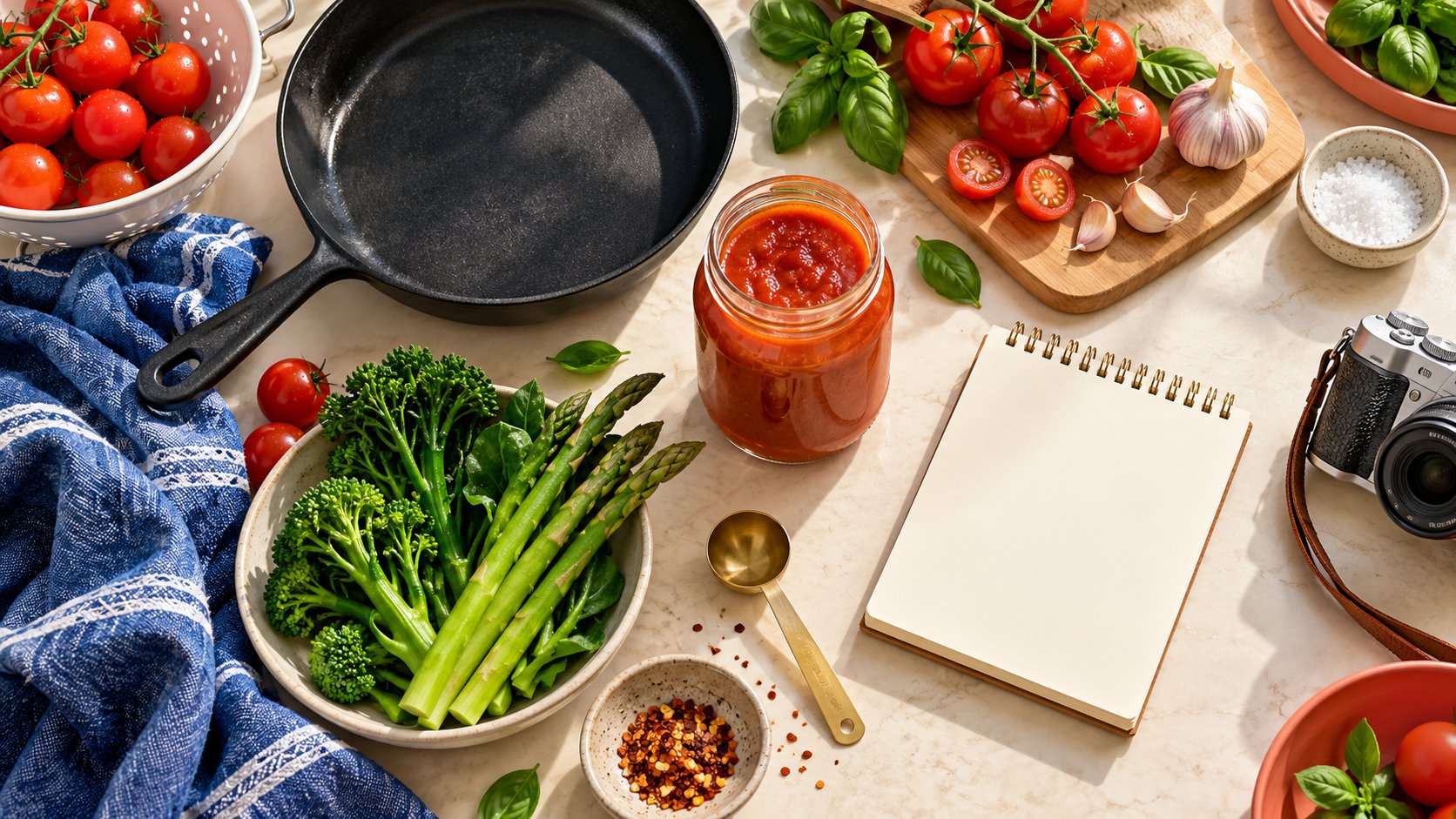
AI-generated editorial illustration; people are not the creators named in this article.
THE SHORT ANSWER
A food-influencer assignment should define what the product does in one dish or situation. Specify ingredients, testing, priority shots, product facts, samples and revisions, while preserving honest taste experience and creative judgment. A reference list helps discovery; an execution brief must survive the actual kitchen. This guide follows a fictional sauce demonstration from product task to acceptance, complementing the separate guide to prominent food-content formats.
Scope one kitchen problem
Suppose the brand wants to explain how a sauce helps with a weekday dinner. The assignment can be a complete repeatable meal demonstration. Do not also demand proof of weight loss, savings, universal child approval and compatibility with every cooking method. Each claim would create another task and evidence requirement.
State the customer’s experience, equipment and realistic time constraints. The creator can then identify the step that needs explanation instead of filming only a finished plate and package. The useful-brief guide helps set this boundary. A narrow kitchen question makes the deliverable easier to quote, produce and accept, because both parties can recognize whether the content actually helped someone understand how the product is used.
Separate reference format and production scope
Joshua Weissman’s official recipe categories and collections provide a route for studying how cooking information is organized. They do not mean a brand needs to copy his style or that another creator should reproduce a reference frame by frame. Select a structural lesson relevant to the product task.
Specify short video, written recipe or both. Each format requires different instructions, ingredients and deliverables. The food-format guide helps compare those roles. Avoid beginning with one content item and later adding every possible adaptation. A reference should communicate the customer experience the brand wants, while leaving the creator room to propose an original execution within a scope that can be priced and completed realistically.
Provide testing materials and contingencies
Confirm the product version, quantity, shelf-life and storage information, and allow enough material for testing. If special ingredients are required, state who purchases them and how additional cost is approved. Provide accurate allergen information rather than expecting a reviewer to infer it from the image.
Agree on replenishment and scheduling if a product or ingredient fails during preparation. A recook is not necessarily a costless minor edit. The seeding logistics guide covers the shipment record behind this work. Kitchen production has physical dependencies: the correct sample, usable ingredients and enough time must exist together. A clear contingency reduces the chance that a creator improvises an unsuitable substitute simply to meet a date the brand no longer has the conditions to support.
Prioritize shots by explanatory value
List the actions viewers must see: quantity, mixing state, the relevant heating stage and final texture. Separate essential explanatory shots from flexible atmosphere. Requiring several seconds of package visibility does not guarantee that the audience understands the product.
Before filming, confirm that the item can genuinely be used with the specified equipment or conditions. Product facts need brand review before production rather than an attempt to fix an unsuitable assignment through editing afterward. The brief-change guide helps handle new requests. A prioritized shot list also makes constrained production more practical: if time is limited, both parties know which explanation must remain and which decorative element can be simplified without undermining the purpose of the content.
Separate facts, taste and product claims
Ingredients, quantities and storage are factual information. “I found the flavor richer” describes an experience. A statement about improving health is a different kind of claim needing appropriate support. Keep these categories distinct during review instead of turning them into one compulsory brand slogan.
FTC health-product guidance is a US reference for health-related advertising statements. If the assignment is an ordinary kitchen demonstration, there is no need to add an unsupported outcome promise. The brand should supply the facts it controls and allow honest experiential description. An approval process can correct an ingredient error without requiring the creator to express a taste preference they do not hold or converting a personal impression into a universal product result.
Let the intended use determine rights
If the brand wants product-page, advertising or translated use, confirm duration, channels and editing in advance. Published recipes, photographs and videos should not be copied automatically. The intended use should determine the license instead of the team discovering the need after a strong asset appears.
When extracting one step for an advertisement, check that the edit preserves the original meaning. Define raw-footage delivery, music and third-party material as relevant to the assignment. The rights guide develops these choices. A technically attractive clip can still be unusable for the brand’s intended channel if the underlying permissions were never obtained. Planning them early prevents a successful kitchen shoot from ending with a licensing gap.
Worked example: identify a reshoot
Suppose the original assignment is a warm sauce demonstration and the brand later requests a cold salad. Both use the same product, but ingredients, process and footage change. That is a new production request rather than a subtitle correction. Identify the changed work before asking the creator to proceed.
If the fictional original budget is $1,500 and added ingredients and production cost $350, the revised total is $1,850. These are invented prices, not market rates. Approve the actual quote and timing before execution. A clear change process protects the schedule and lets the brand decide whether the new idea is worth purchasing instead of treating any request involving the same product as automatically included.
Keep the shopping list aligned with the approved recipe version. A substituted ingredient can change texture, preparation or the factual information supplied, so identify who approves substitutions before the shoot rather than asking the editor to conceal a mismatch in the final sequence.
Accept the task, then review outcomes
Accept the steps, facts, format, disclosure, link and rights before interpreting views or purchases. Low sales do not automatically mean the recipe was poorly produced, particularly when the destination was unavailable or the link failed. Keep delivery and outcome questions distinct.
QuickKOL can help interpret candidate content and prepare relevant outreach. After the project, preserve the approved version, live URL and consistently timed evidence. The conversion guide helps inspect the commercial path. The next brief should learn from what happened in the kitchen: whether samples were sufficient, the explanation was clear and the change process worked. That record makes future collaboration more reliable than choosing the next food influencer solely because a recent video attracted more attention.
Research date, evidence and limitations
Sources reviewed October 21–22, 2026. Workflows are editorial recommendations and numerical examples are hypothetical, not observed campaign results, creator rankings or offers.
The working sheet for this task
Editorial analysis and labeled hypothetical examples, not performance rankings, quotes or guarantees.
| Decision | Evidence to keep | Next action |
|---|---|---|
| Preparation | Samples, ingredients and facts | Allow testing |
| Production | Essential steps and shots | Prioritize explanatory value |
| Acceptance | Version, links and rights | Review outcomes separately |
CHECKLIST
Before you put this into practice
Record the answers in the campaign working file.
- Choose one kitchen question
- Separate facts and taste
- Identify recooks as production
- License intended reuse
Sources and further reading
External pages can change. Recheck platform rules, contracts and local law before launch.