
THE SHORT ANSWER
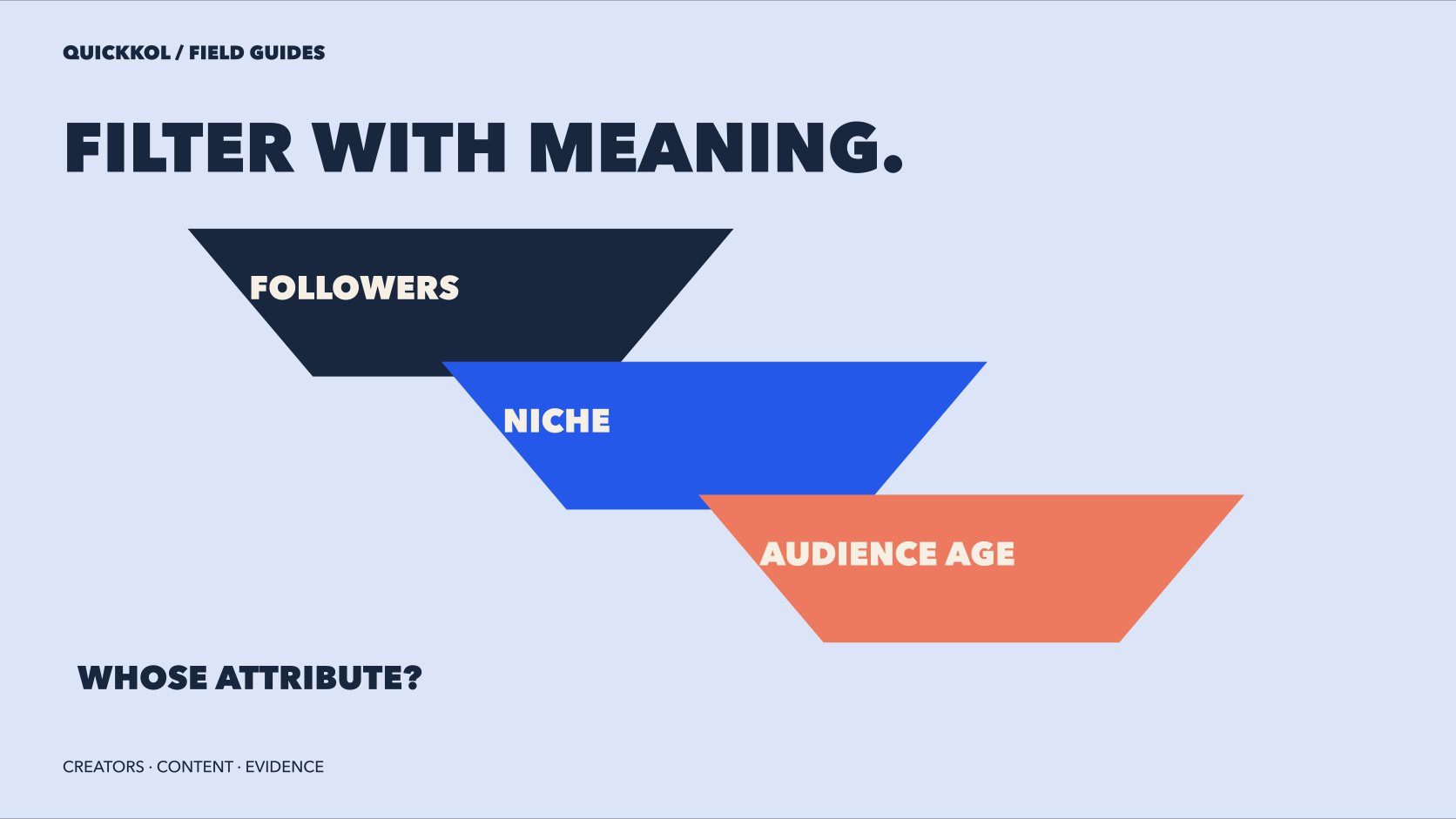
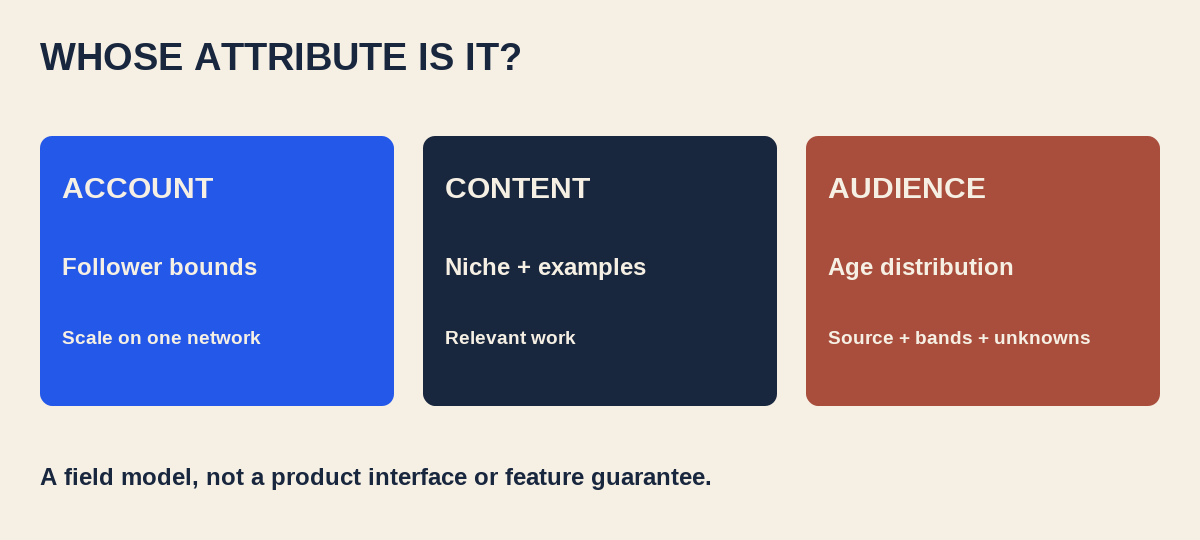
Before combining follower count, niche and age in an Instagram influencer search, define whose property each field describes. Followers concern account size, niche needs content evidence and age may mean the creator’s age or an audience distribution. Those are not interchangeable. Ask a platform to show the combined query, data provenance and treatment of unknown values. This article explains how to specify and validate the search; it does not claim QuickKOL provides every exact filter combination mentioned in the keyword.
Rewrite the long keyword as a search specification
Suppose the brief asks for English-language home-workout content, 20,000–80,000 followers and a specified share of an adult target audience band. Record the social network, numeric bounds, content evidence and audience condition as separate requirements. These hypothetical bounds are a project specification, not an industry recommendation.
Explain why the age condition matters. A product-use situation may require relevant experience or audience fit without requiring the creator’s personal age. A clear specification prevents the team from requesting intrusive or unreliable attributes simply because a tool might display them. Define the customer need first and collect only the evidence needed to evaluate it.
Use follower bounds to control size, not relevance
Record whether lower and upper bounds are inclusive, when counts refresh and whether every result refers to the same social network. An account can move across a boundary as its audience changes, so retain the query date and the observed count used for the decision.
Do not interpret 20,000 versus 19,900 followers as a meaningful difference in storytelling capability. A numeric gate can reduce the review pool, but final evaluation still depends on relevant work and the assignment. If the brand needs a strict range for an operational reason, document that reason. Otherwise inspect near-boundary candidates before discarding an unusually strong content match.
Validate niche labels against actual work
“Fitness” can include strength training, running, yoga, recovery stories and lifestyle content. Narrow the request using subtopics, presentation formats and exclusions. Review comparable work rather than accepting the category label. A keyword in a caption does not prove it represents the account’s main direction.
Separating home bodyweight tutorials from gym-fashion posts can be more useful than adding another broad interest filter. Keep one sentence explaining why each candidate matches the task, with a specific example. The reproducible search guide helps preserve this reasoning so a teammate can repeat the query and understand why apparently similar accounts received different decisions.
Label age as creator age or audience age
Modash’s search-filter documentation includes audience-age conditions. That does not establish that every platform supports creator-age filtering or that QuickKOL has the identical filter. Check the exact field name, age bands and coverage before treating a result as compliant with the brief.
Do not infer age from appearance, a name or one post. If provenance or coverage is unclear, retain an unknown value and obtain appropriate authorized evidence when necessary. An audience estimate also has limits: it is not a verified identity record for every viewer. The useful question is whether the available evidence supports the project decision at the required level of confidence.
Test combined logic, unknowns and query changes
Run a baseline query, add the niche condition and then add the audience requirement. Observe how the candidate pool changes. Confirm AND versus OR behavior, minimum-share thresholds and the meaning of language and geography fields. Zero results can reflect narrow conditions or limited coverage rather than the absence of any suitable creators.
Relax one condition at a time and record why. Do not quietly remove the target market to produce an impressive result count and then label the output a match to the original brief. A useful search log preserves the trade-off. It lets the campaign owner decide whether broader scale is worth a weaker fit.
Turn query results into outreach-ready candidates
A usable output includes the account route, relevant work, observed values, source, query date and remaining questions. Passing the search does not establish commercial availability, price or willingness to collaborate. The shortlist workflow helps convert a filter result into a reviewable candidate record.
QuickKOL can support brief interpretation, relevant content discovery and reasons for outreach. Confirm identity and the commercial contact route before sending. If required age evidence remains unavailable, state the open condition internally rather than presenting a doubtful number as a personal fact in the invitation. Search precision matters only when the resulting collaboration can be evaluated and approached responsibly.
Worked example: specify an audience-share condition
Suppose the project requires at least 40% of a defined adult audience band. First confirm whether the tool’s age bands actually correspond to the requested interval, which population forms the denominator, whether the value is estimated and how unknowns are treated. The percentage is a hypothetical project condition, not a recommended threshold.
Do not combine incompatible age bands or assume that a broad interval proves a narrower one. If the available breakdown differs, revise the question or obtain an appropriate source. A nearby estimate should not become an exact pass simply because the result looks convenient. Record what can be supported and what remains unresolved.
The same care applies to combined geography and age conditions. Separate marginal percentages do not necessarily establish the joint share of viewers meeting both requirements. Ask what the displayed field actually measures. If the tool cannot answer the combined question, say so and let the campaign owner decide whether that uncertainty is acceptable. A transparent search specification is more useful than an elaborate filter string whose output appears precise but does not correspond to the customer population the brand intended to evaluate.
FAQ: do zero results mean no suitable creators exist?
No. Coverage, keywords, language, thresholds and combined logic can all constrain the result pool. Inspect those factors one at a time. A zero-result query is evidence about that query in that dataset, not proof that the entire market lacks suitable creators.
Start from a simpler baseline and reintroduce each condition. Record which change removes candidates and whether it reflects a genuine mismatch or missing coverage. If a requirement is relaxed, preserve the original version and explain the trade-off. Do not silently drop the target market or audience condition and label the new output a complete match.
When age evidence cannot be used reliably, content and use-context research may still proceed. Mark the age condition unresolved in the candidate record and decide when it must be verified before a commercial commitment. This lets the team make useful progress without pretending that an unavailable field has been satisfied. A good search workflow supports both discovery and honest uncertainty; it does not need every early result to look fully qualified in order to be valuable.
Research date, evidence and limitations
Modash documentation checked October 21, 2026. No comprehensive combined-filter trial across platforms or QuickKOL is claimed. This is a search-specification and verification method.
Three fields with different meanings
Editorial analysis and labeled hypothetical examples, not performance rankings, quotes or guarantees.
| Field | What it describes | Verify |
|---|---|---|
| Follower range | Account scale on a network | Bounds, freshness and account |
| Niche | Content and use context | Comparable work and exclusions |
| Age | Creator or audience: specify which | Source, bands, coverage and unknowns |
CHECKLIST
Before you put this into practice
Record the answers in the campaign working file.
- Define each field
- Specify whose age is meant
- Test combined query logic
- Do not present unknowns as verified matches
Sources and further reading
External pages can change. Recheck platform rules, contracts and local law before launch.