
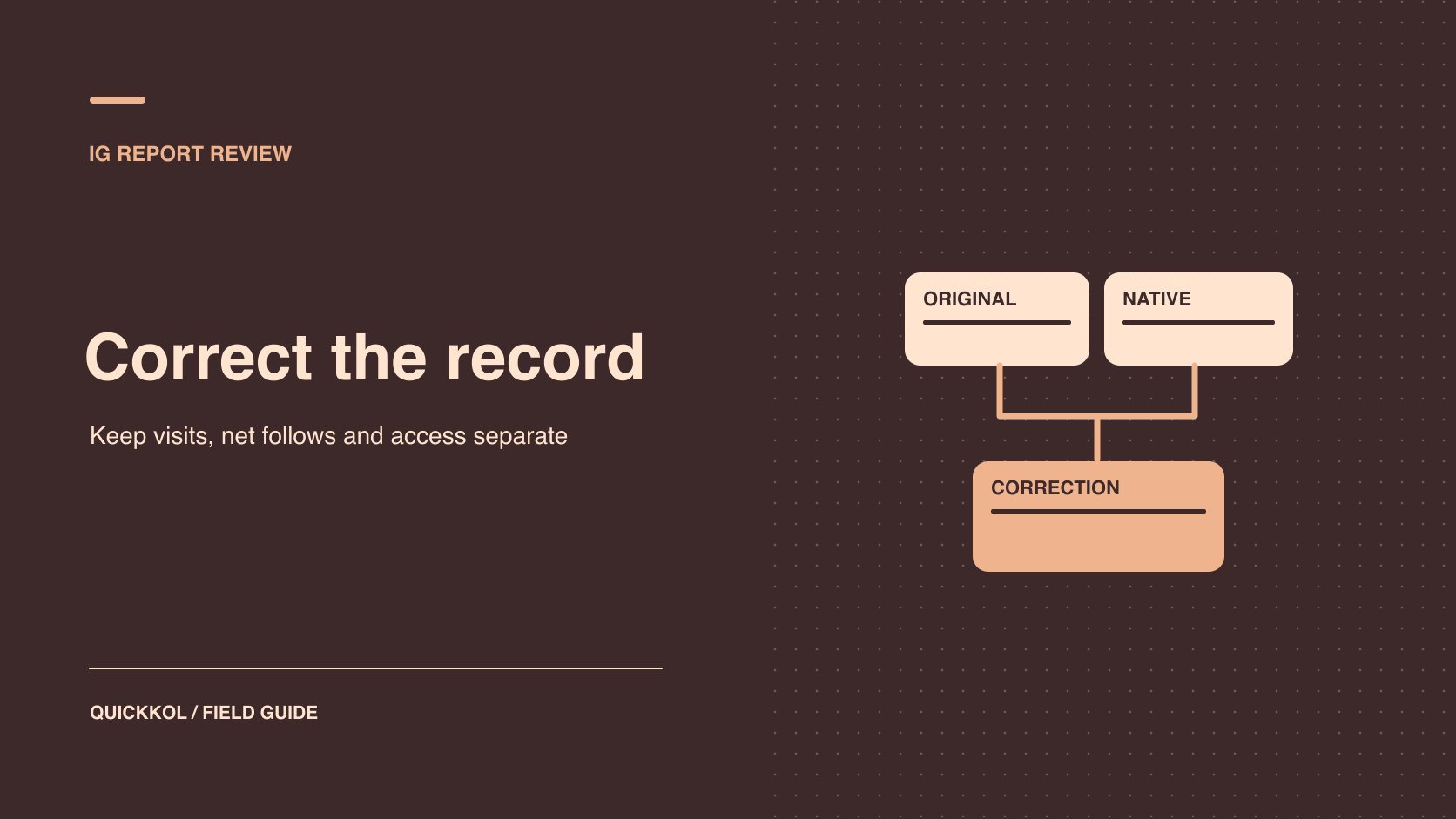
QuickKOL editorial graphic; not actual account metrics or a platform interface.
THE SHORT ANSWER
If a free IG followers offer appears alongside unusual agency reporting, check access and measurement independently. Have the creator or authorized owner verify account grants. Ask the analyst to reconcile account, time zone, net follows, visits and advertising sources. Keep the original and mark which reports and payment lines the correction affects. Describe artificial engagement only to the extent the evidence establishes it. The sponsor can still accept documented creative under the agreed terms.
Turn the offer into a record of verifiable facts
Collect the original offer language, the discovery time, the recipient and any action someone actually took. A link forwarded in a group chat does not mean the agency used it. Identify whether the offer promised a total, a daily increase, reciprocal follows or another result. Ask whether it requested anything beyond the handle. Meta’s fake engagement enforcement announcement described examples of bots and automation used to inflate Instagram followers and likes. Those cases establish that such mechanisms exist. They do not establish the conduct of a service, agency or creator in a current review.
If the supplier described the result as free and stable, have the commercial owner check for later charges, app connections or automation conditions. Give the offer, work order, payment, authorization and delivery their own evidence fields. A screenshot often supports just one of those fields. Preserve where it came from, without attaching it to unrelated creator records. Ask the contracted creator about a specific period and action. That gives them a way to respond with records instead of having to rebut someone else’s speculation.
Have the owner check four access paths
Inventory four access paths: public handles, external app grants, business asset or people permissions, and actual sign-in credentials. A handle is a public identifier. An agency partner might have permission to view an ad report, to publish or to manage some part of an asset. Review app connections separately from the role assigned to an agency employee. Record purpose, approver, current state, expiry and who can revoke it. An unknown purpose needs review by the real owner, who may see different information from the agency.
Meta’s clone-site explainer describes how imitation websites can deceive visitors into giving up credentials. If someone entered a password or code into an unfamiliar page or reports unusual behavior after connecting an app, have the owner use the official account-security route from a trusted device. Review devices, connections, unexpected posts and changed links as appropriate. Redact private details when capturing access evidence. Restrict the underlying file and record only the access category and campaign impact in the agency report. If no unfamiliar app appeared, write down the interface checked and the date. That observation does not establish that there was never any exposure.
Align the account, time zone and counting rule
Send the agency a three-column reconciliation sheet: original field, location of underlying evidence and correction required. Confirm the creator’s actual publishing handle and URL in the first row. Freeze the reporting interval and time zone in the second, including whether the end date was inclusive. In the third, establish whether “follower growth” means end minus start, native net change, follow events, an estimate or a total across accounts. If the agency subtracted two public tracker readings, retain the two timestamps and label the result an estimate.
Use an Instagram two-source reconciliation to place native evidence beside external observations. A discrepancy of several hundred can reflect display rounding, different capture times, an account rename or a regional subaccount in the agency export. If native gains and losses are available, use the same window for both columns. Mark unavailable dates or restricted fields as unknown and assign them to the source owner. A narrow evidence request can usually get the review moving. Ask the creator for one week of native trend and the report filter, without requesting a list of followers or sign-in credentials.
Test explanations against content and ad delivery
Place actual content and delivery events next to the growth observation: publication of a partnership post, a creator mention, a giveaway, an event or the start and pause of paid delivery. Meta’s Reels metrics explainer describes watch time and follow information from Reels. A metric for one content item does not replace net change across the account. Confirm that the row refers to the campaign’s asset. Check for brand advertising and reposts that change how sources should be interpreted. Then look for related profile visits, substantive comments, follows and return activity where comparable data exists.
Suppose the report says 1,600 gained. Native net change is 640, and an ad report shows 960 profile visits. The sum matches 1,600, but a visit and a follower are different units. Correct the combined figure before deciding whether any remaining growth needs explanation. If the owner finds an unauthorized grant, send that through the access review. The arithmetic error does not tie the increase to that grant. Use a consistent creator engagement reading method to examine participation and avoid treating comment language, follower geography or posting time as stand-alone evidence.
Define exactly what the correction changes
When the agency sends new evidence, preserve the original and require a versioned replacement. Include the old value, verified replacement, reason, source, owner, date and downstream impact. In the example, “1,600 followers gained” becomes “640 net follows; 960 paid profile visits reported separately.” Any unresolved organic versus paid attribution can stay open. If the earlier number appears in minutes, a dashboard, a case study or a renewal offer, give the relevant owners the same correction and track which versions they replaced.
Then check whether the dispute affects payment. Production, publication, brand usage rights and a metric-based bonus can have different acceptance requirements. A verified but unattributed net increase does not automatically count as agency delivery. It does not automatically invalidate the video fee either. Give the contract owner the provisions that depend on independent evidence. If artificial inflation is established, describe which evidence supports which mechanism, and limit the finding to the relevant account and period. Keep the creator’s reply with the record so another reviewer can see whether the original capture or identity match was challenged.
Make unresolved items actionable at the next review
Unknown is a real status with an owner. Each open item should identify the missing evidence, whether it affects security or payment, who can supply it and the latest review date. If the native value has been corrected while its source is unclear, agree on which matched report the analyst will inspect next. Notify the account owner separately when there is an access lead. If the only confirmed issue is incorrect metric naming, retain the correction and close the access question within the scope examined. That need not trigger a wider request for personal data.
Consider a manager who confirms that a growth-service link was shared but no grant was visible in the interface reviewed. The increase remains unexplained. The status can read “connection not observed in the reviewed record; source of growth unknown.” If the creator later sees an unusual login, reopen the access item with the date of the new observation. Evaluate whether the campaign content meets acceptance terms on its own evidence. The worksheet becomes a record of work and decisions, instead of a list of provisional judgments about people.
Check which party owns each report source
An agency may only compile creator data while directly administering the advertising account. Require separate ownership fields for the person who captured a screenshot, the person who exported a report and the person who calculated the final number. For example, one row may come from an export the creator supplied while another comes from a brand ad account. If the time zones differ, retain the originals and either export a matched window or label the comparison unavailable. An agency cannot certify that nothing changed inside a creator account it cannot inspect. The appropriate account administrator must own that check.
If a contractor changes, add access requester and approver fields and confirm that previous roles expired as intended. A prior verified grant remains part of the record. Its existence does not establish that it is still active. Give one brand owner responsibility for maintaining the current list and give the creator a direct contact for correcting evidence or suspending access.
When sending the internal correction, include its effective time and scope. For example, “From Tuesday, use the verified 640 in renewal materials. Keep the first three weekly reports with the correction attached.” Preserve a reproducible calculation and use the updated figure with its limits in external materials. A new analyst should be able to find each source, reproduce the arithmetic and explain why the two metrics were kept separate.
Prevent the same reporting error in the next agency handoff
Suppose an agency adds brand ad profile visits to the creator account’s net follows and uses the result in a renewal recommendation. Reproduce the old figure from the available sources and record which report needs a correction and who should receive it. The contracted creator confirms the account and relevant window. The brand media owner confirms the ad object. The analyst replaces the merged value. Preserve acceptance for the work that was published as agreed.
In the next brief, name the report source, extraction date and person authorized to share it. Rehearse the reconciliation using one sponsored asset. Check that zero and unavailable values remain distinct. Where a report cannot isolate promotion sources, base settlement on observable delivery or leave attribution unresolved under the agreement. The creator should have a narrow evidence request and the sponsor should have a reliable record of the decision.
Research date and limitations
Sources reviewed November 9, 2026. Methods, tables and decision rules are editorial recommendations. Hypothetical examples are not actual client results or industry benchmarks. Source geography and periods are specified where relevant.
Four fields for an agency correction
Hypothetical values demonstrate the correction format.
| Field | Example | Owner |
|---|---|---|
| Original value | Report stated 1,600 gained | Agency analyst |
| Verified replacement | 640 net; visits separate | Data owner |
| Access status | No unfamiliar app in reviewed interface | Account owner |
| Downstream impact | Revise recap and renewal deck | Brand campaign owner |
CHECKLIST
Brand review checklist
Confirm each item before issuing the correction or settlement decision.
- Preserve the offer wording and confirmed actions.
- Check apps, roles, credentials and devices separately.
- Compare native and external evidence in matched windows.
- Record the old value, replacement, reason and downstream materials.
Sources and further reading
- 01Meta’s fake engagement enforcement announcement
- 02Meta’s clone-site explainer
- 03Meta’s Reels metrics explainer
External pages can change. Recheck platform rules, contracts and local law before launch.