
THE SHORT ANSWER
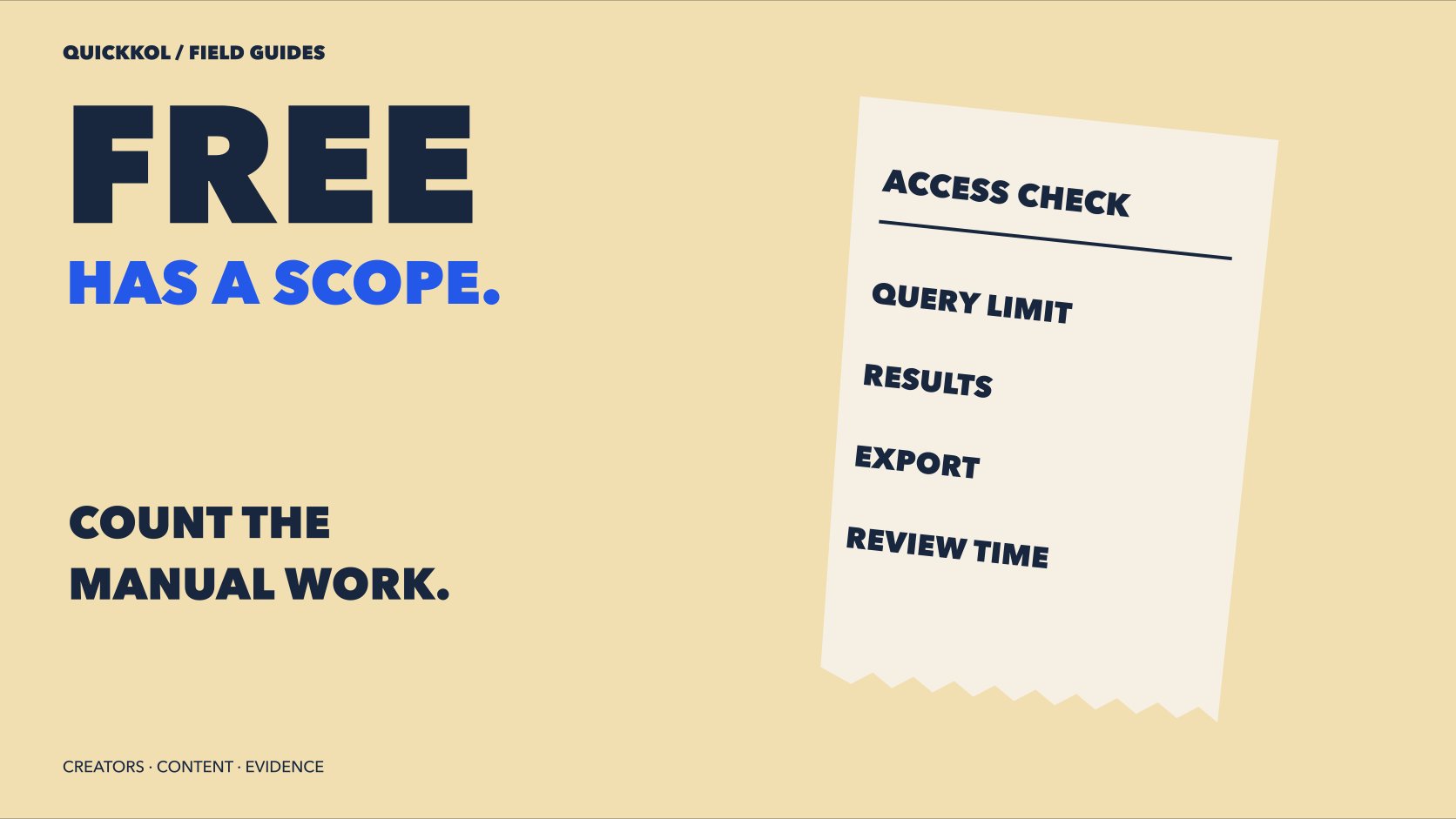
A free Instagram influencer search tool with a follower-count filter is useful when its accessible version completes a defined small task. Check registration requirements, returned results, provenance, query allowances and export limits. A visible filter or trial advertisement is not a promise of permanent free access. This guide gives you a repeatable evaluation method rather than an unverified directory of supposedly free products. QuickKOL is discussed for relevant discovery work, without promising a free tier or exact filter entitlement that has not been confirmed.
Define what free access means
An account-free utility, registered allowance, time-limited trial and free query with paid results are different access models. Open the actual route and record the date, terms and actions available. Do not import a large working list before discovering that the required output is behind an upgrade.
Decide whether the immediate goal is ten research leads, verified commercial contacts or a continuous team workflow. Those require different access. A tool can be useful for the first task and unsuitable for the third without its free offering being misleading. Evaluate the task you need, and keep an accurate record of where the free portion ends.
Run a bounded evaluation task
Suppose the task is to find ten research candidates publishing English-language baking tutorials with 10,000–50,000 followers. Record both the number returned and the number that survive content review. These hypothetical bounds define the test; they are not a recommendation for every food brand.
A follower match is not a niche match, and ten public leads do not equal ten commercially available partners. Keep one relevant example per candidate and the question that remains before outreach. This modest assignment is enough to reveal whether the filter saves effort without requiring the team to purchase a subscription merely to understand the basic output.
Test the follower filter and returned records
Check lower and upper bounds, social network, count date, missing values and duplicate identities. Change one boundary to see whether the results behave as expected. If the accessible version lacks the filter, a small manual review may still be feasible, but describe that workaround accurately rather than calling it equivalent automation.
When counts disagree, compare observation dates and account identity before deciding the tool is wrong or the creator is dishonest. A useful pilot records exceptions as well as successful matches. The account identity guide helps when a creator uses similar names across networks or when repost accounts make a result look more complete than it is.
Do not mistake free results for a complete audience audit
Public followers, public content and vendor estimates have different limits. Target-market evidence, audience age, current authorized analytics or commercial contact information may be absent from the free output. Mark missing fields unknown rather than filling them with assumptions from a profile photograph or biography.
Modash’s filter documentation helps illustrate distinct search fields, but it is not a promise about free entitlements in this guide. Confirm accessible features in the actual product on the day you evaluate it. A useful lead-generation result can still require later audience verification. Keep those stages separate so an initial free search does not acquire more certainty as it travels through the team.
Include manual effort in the cost
Suppose a free workflow takes 120 minutes to produce eight qualified research leads: fifteen minutes each. Another takes forty-five minutes for nine leads: five minutes each. These hypothetical figures show that a zero subscription price can still carry different labor costs. They do not establish that a paid product is more accurate.
Whether to upgrade depends on future volume, cleanup, permissions and usable exports. Identify which limit actually blocks work. A small team with occasional searches may reasonably accept manual steps, while a repeated workflow may make the same steps expensive. The free search pilot guide helps turn the trial into an operating decision rather than a reaction to an attractive upgrade screen.
Keep a record that survives changing tools
Retain permitted account routes, relevant work, observation dates and next questions. Do not bypass access controls to turn a limited result into a larger dataset. Confirm the identity and appropriate commercial contact route before outreach. A portable research record lets the team continue even when a trial expires or the product no longer fits.
QuickKOL can support the path from a brief to relevant content and outreach preparation; verify current pricing and access in the product. Once the small task succeeds, decide whether a recurring workflow is justified. A free search has done its job when it supports the next informed decision, not when it produces the largest unreviewed spreadsheet.
Worked example: compare two accessible free routes
Suppose free route A returns fifty accounts, six of which have relevant work, while route B returns twelve accounts, eight of which are relevant. The larger result count does not automatically make route A more useful. Record the time spent reviewing, deduplicating, finding evidence and producing an output a teammate can use. These figures are hypothetical evaluation examples.
Also compare what the accessible version permits the team to retain. A result visible on screen may not include a usable export or the fields needed for later review. Do not bypass those restrictions. Decide whether a small permitted manual record is enough for the immediate task or whether the missing capability blocks it.
One successful output does not establish a permanent allowance. Confirm trial expiry, recurring access and any relevant changes before relying on the route for ongoing work. The evaluation should end with a specific conclusion: useful for a limited research batch, suitable for recurring use under known terms or insufficient for the required output. That conclusion is more informative than declaring one tool the best free option from the number of profiles shown on its first screen.
FAQ: when should the search for a free option stop?
Reassess when continued tool hunting consumes more effort than the immediate task is likely to save. Free access is a constraint, not the underlying objective. The objective is completing relevant research. The team can narrow the assignment, accept a transparent manual step or evaluate a paid route if those choices fit the budget.
Payment does not automatically solve accuracy, coverage or workflow quality. Before upgrading, run the same task and identify exactly what becomes available and what remains missing. A paid export of unsuitable profiles is still an unsuitable output. A subscription should not be purchased merely because the team has already spent a long time searching for alternatives.
Keep the decision reversible where practical. Complete a bounded batch, preserve the permitted working record and review the actual effort before committing to a longer workflow. This approach respects a limited budget without turning the free-tool search into an endless project of its own. The right stopping point is the route that supports the next informed campaign decision at an acceptable total cost, with its restrictions stated clearly.
Research date, evidence and limitations
Research sources checked October 21, 2026. No vendor’s permanent free access, exact filter entitlement or result allowance is promised. Time and counts are hypothetical.
A free-tool pilot record
Editorial analysis and labeled hypothetical examples, not performance rankings, quotes or guarantees.
| Question | Record | Decision |
|---|---|---|
| Where does free access end? | Date, route and terms | Can this task be completed? |
| Does the filter work? | Bounds and sampled results | Range match still needs content review |
| Can the output be used? | Export, provenance and unknowns | Can the next owner proceed? |
| What is the labor cost? | Minutes per qualified research lead | Is repeated use worthwhile? |
CHECKLIST
Before you put this into practice
Record the answers in the campaign working file.
- Verify access on the evaluation date
- Test follower boundaries
- Review content relevance
- Record time per qualified lead
Sources and further reading
External pages can change. Recheck platform rules, contracts and local law before launch.